How to Know What Your Business Can Really Afford
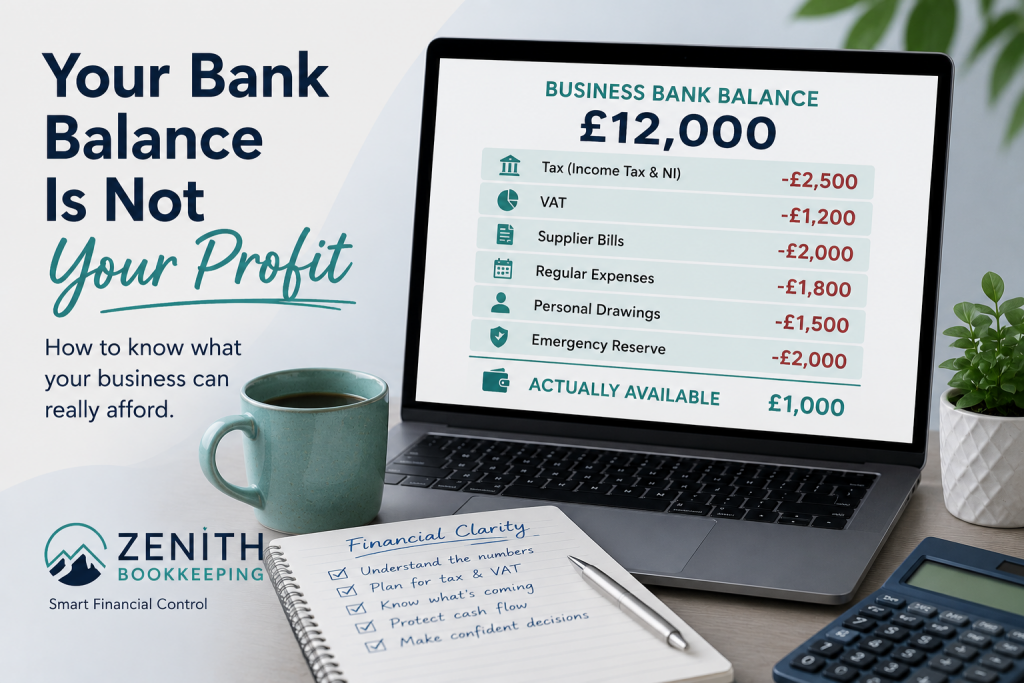
You open your banking app, smile, and see £12,000 sitting in the business account.
For a moment, everything feels reassuring.
There is enough there to pay yourself.
Perhaps replace that laptop that has been struggling for months.
Maybe take a little more out of the business after what has been a particularly busy period.
After all, the money is there. But is it really available?
In our recent articles, we have looked at the problems caused by late payments and the importance of building a separate tax pot. Both lead naturally to another important principle:
The balance in your business bank account is not the same thing as your profit, and it certainly is not the same thing as the amount you can safely spend.
For many sole traders, understanding that distinction is one of the biggest steps towards calmer financial control.
Because a bank balance tells you where you are today.
It does not tell you everything that money still has to do tomorrow.
The £12,000 that is not really £12,000
Let us imagine your business bank account shows a balance of £12,000.
It looks healthy.
But then you start looking beneath the headline number.
Perhaps:
- £2,000 needs to cover supplier bills.
- £2,500 should be reserved for Income Tax and National Insurance.
- £1,200 represents VAT that may ultimately need to be paid to HMRC.
- £900 is needed for insurance and subscriptions due next month.
- £1,000 needs to remain available for materials for upcoming jobs.
- £1,500 is required for your normal personal drawings over the next few weeks.
Suddenly, the comfortable £12,000 balance looks rather different.
The money has not disappeared.
You have simply identified the jobs it already needs to do.
That is the difference between seeing money and understanding money.
And good bookkeeping should help you do the second.
Bank balance, turnover and profit are three different things
These terms are sometimes used almost interchangeably in everyday conversation.
They should not be.
Turnover
Turnover is broadly the income generated from the sales your business makes before expenses are taken into account.
If you invoice customers for £80,000 over the year, that may broadly represent your turnover.
But it does not mean you have personally made £80,000.
The business still has costs.
Profit
Profit is what remains after the relevant business expenses have been deducted from business income.
HMRC requires self-employed people to keep records of their business income and expenses, and those records are used to work out the profit reported through Self Assessment.
If you generate £80,000 of income but incur £45,000 of allowable business costs, the financial picture is very different from a business generating £80,000 with only £10,000 of costs.
Bank balance
The bank balance is simply the amount of cash in the account at that particular moment.
It can be influenced by:
- Customers paying early or late.
- Bills not yet being paid.
- Money transferred into the business.
- Personal withdrawals.
- Tax that has not yet been paid.
- VAT collected.
- Large purchases.
- Loans or finance.
- Seasonal fluctuations.
That is why a healthy-looking bank balance does not automatically mean the business is highly profitable.
And a temporarily low balance does not necessarily mean the business is making a loss.
Timing can create a false sense of security
Imagine you receive three large customer payments in the same week.
Your account suddenly looks extremely healthy.
But perhaps those invoices relate to work completed over the previous two months.
Meanwhile, several costs connected with delivering that work have not yet been paid.
The money arrives first.
The bills follow later.
For a brief period, the bank balance looks stronger than the real financial position.
This is one reason financial decisions should not be based on the balance alone.
Ask a second question:
What is already committed?
Money can be in your account without really being available
Some of the most common examples include the following.
Tax
As we discussed in “The Tax Pot Habit”, some of the money earned through the business may ultimately be needed for Income Tax and National Insurance.
Self Assessment can also include payments on account towards the following year’s bill. These are generally paid in two instalments, on 31 January and 31 July, where the relevant conditions apply.
That money may remain in your bank account for months.
That does not make it spare cash.
VAT
If your business is VAT registered, you may collect VAT from customers on taxable sales.
HMRC describes output VAT as the VAT you charge and collect from customers. Businesses generally account to HMRC for the difference between output tax and eligible input tax they can reclaim.
Again, that cash may temporarily increase your bank balance.
But part of it may ultimately belong to HMRC.
Supplier bills
You may have received materials or services but not yet paid the invoice.
Until the supplier is paid, the bank balance includes money needed to meet that commitment.
Annual costs
Some bills do not arrive every month.
Insurance.
Professional memberships.
Software renewals.
Vehicle costs.
Equipment servicing.
Annual subscriptions.
If you only look at this month’s bank balance, these future costs can be easy to forget.
A profitable business can still run out of cash
This is one of the most important principles in small-business finance.
You can be doing profitable work and still experience cash-flow pressure.
Imagine you complete £10,000 of profitable work this month.
That sounds excellent.
But suppose customers will not pay for another 30 or 60 days.
Meanwhile, you have already paid:
- Materials.
- Fuel.
- Subcontractors.
- Insurance.
- Rent.
- Software.
- Household drawings.
The profit may exist on paper, but the cash has not arrived yet.
That is precisely why late payment matters so much.
Profit tells you whether the work ultimately makes financial sense.
Cash flow tells you whether you can survive the journey between doing the work and receiving the money.
You need to understand both.
The opposite can happen too
A strong bank balance can disguise weak profitability.
Suppose you have £20,000 in the bank.
That sounds excellent.
But perhaps £10,000 came from a business loan.
Another £5,000 represents unpaid VAT and tax commitments.
The underlying business may actually be struggling to generate sufficient profit from normal trading.
Cash in the account can therefore make a weak business look temporarily stronger than it really is.
Again:
The number on the banking app needs context.
Paying yourself does not reduce taxable profit in the way a business expense does
This can be another source of confusion for sole traders.
If you transfer money from the business account to your personal account, you may naturally think of that as your “wage”.
But for a sole trader, money taken from the business for personal use is not treated as an allowable business expense when calculating taxable profit. HMRC explicitly states that allowable expenses do not include money taken from the business for personal use.
That means the question:
“How much have I taken out?”
is different from:
“How much profit has the business made?”
You might make a £40,000 business profit and personally withdraw £30,000.
Or withdraw £45,000 because you are also using cash accumulated from an earlier period.
Your withdrawals do not automatically tell you the profitability of the current year.
This is another reason good records matter.
Give every pound a job
One of the simplest ways to improve financial control is to stop viewing the bank balance as one large pool of money.
Instead, think in categories.
Your money may need to cover:
Tax
Money reserved for future Income Tax and National Insurance.
VAT
Where applicable, money needed for the next VAT payment.
Operating costs
The everyday costs of keeping the business running.
Supplier commitments
Bills received or expected for goods and services already purchased.
Personal drawings
The amount you need to take from the business to support yourself.
Reserves
Money set aside for unexpected events or quieter periods.
Planned investment
Equipment, training, marketing or other expenditure you have deliberately decided to fund.
Once money has a defined purpose, the question becomes much clearer.
Instead of asking:
“Can I afford this?”
you can ask:
“Which pot would this money come from, and what happens to that commitment if I spend it?”
That is a much better business question.
A separate bank account can help — but it does not solve everything
Keeping business and personal transactions separate can make financial control much easier.
It reduces confusion and makes record keeping simpler.
But simply having a separate business account does not automatically tell you what the money inside it is for.
You may benefit from additional savings spaces or separate accounts for things such as:
- Tax.
- VAT.
- Emergency reserves.
- Annual costs.
- Planned investment.
The objective is not to create twenty different accounts.
It is to make important commitments visible.
If your tax pot contains £5,000, you are much less likely to mistake that £5,000 for spending money.
Know what is coming out next
A useful financial habit is to look forward, not just backwards.
Many owners know what they spent last month.
Fewer can confidently say what needs to leave the account over the next four or eight weeks.
Create a short forward-looking list.
Include:
- Supplier invoices.
- Direct debits.
- Rent.
- Wages or subcontractors.
- Tax.
- VAT.
- Insurance.
- Vehicle payments.
- Loan repayments.
- Software.
- Personal drawings.
- Planned purchases.
You do not need a complicated forecasting system to begin.
Even a simple list of known commitments can dramatically improve your understanding of the bank balance.
Now look at what is coming in
Next, review expected receipts.
But be realistic.
There is an important difference between:
- Money already in the bank.
- An invoice due tomorrow.
- An invoice already overdue.
- Work completed but not yet invoiced.
- Work booked for next month.
- A quotation the customer has not yet accepted.
All of these may eventually create cash.
They should not all be treated as equally certain.
This connects directly with “Late Payments Shouldn’t Keep You Awake.”
A customer promising to pay on Friday is not the same thing as the money being in your account on Friday.
Until it arrives, it remains a receivable — not spendable cash.
Build a simple four-week cash view
One of the most useful things a small business can do is create a rolling short-term view.
Ask:
What is in the bank today?
Start with the actual balance.
What money is reasonably expected to arrive?
Include customer payments where there is a realistic expectation of receipt.
What definitely needs to leave?
Include known business commitments.
What should be reserved?
Tax, VAT, planned annual costs and emergency funds should not be casually included in your available spending money.
The result does not need to be perfect.
It needs to be better than guessing.
Update it regularly.
As customers pay, replace estimates with actual figures.
As new costs arise, add them.
Over time, the process becomes quicker and increasingly useful.
Create an “available cash” number
This can be far more meaningful than the headline bank balance.
For example:
Bank balance: £14,500
Less:
- Tax reserve: £3,000
- VAT reserve: £1,500
- Supplier payments due: £2,000
- Regular costs before next customer payments: £1,800
- Planned personal drawings: £1,500
- Minimum emergency reserve: £2,000
Available discretionary cash: £2,700
The bank still contains £14,500.
But now you understand that only £2,700 is genuinely uncommitted.
That does not necessarily mean you should spend the £2,700.
It means you can make that decision knowingly.
Clarity changes behaviour.
Watch out for unusually good months
A strong month can sometimes create more financial problems than a weak one.
That sounds strange, but it happens.
Perhaps you land a major contract.
Several large invoices are paid.
Suddenly the account contains more money than usual.
It can be tempting to:
- Increase personal drawings.
- Buy equipment.
- Upgrade the vehicle.
- Commit to new subscriptions.
- Take on additional fixed costs.
But one strong month does not necessarily mean the business has permanently moved to a higher level.
Before increasing regular spending, ask:
- Was this month unusually good?
- Is the income repeatable?
- What does the six-month picture look like?
- Are quieter months likely?
- Have tax commitments increased too?
- Will this extra spending create an ongoing monthly cost?
Use good months to strengthen the business, not automatically to increase its commitments.
Do not confuse affordability with the ability to make the payment
This distinction is particularly important.
If you have £8,000 in the bank, you may physically be able to buy a £5,000 piece of equipment.
The bank will allow the payment.
That does not necessarily mean the business can afford it.
Affordability asks what happens afterwards.
Will you still be able to:
- Pay tax?
- Meet supplier bills?
- Cover a quiet month?
- Pay yourself?
- Handle a customer paying late?
- Deal with an unexpected repair?
Being able to press “Pay Now” is not the same as being able to afford the decision.
Build a minimum balance
Many businesses benefit from establishing a level below which they prefer not to let available cash fall.
Think of it as a financial safety line.
It might represent:
- One month of essential business costs.
- Several months of overhead.
- Enough to cover a major equipment failure.
- Enough to cope with your largest customer paying late.
There is no universal figure that suits every business.
A sole trader with very low overheads may need less than a business that employs staff, carries stock, and operates premises.
The point is to decide consciously.
Without a minimum reserve, every available pound can gradually become spendable.
With one, you create a boundary.
Ask what the business needs before asking what you can take out
Most sole traders need to withdraw money from the business to live.
That is entirely normal.
But instead of deciding on personal drawings purely based on the current bank balance, reverse the process.
Ask:
- What has the business earned?
- What costs must it meet?
- What needs reserving for tax?
- What future commitments are approaching?
- What reserve should remain?
- What can safely be withdrawn?
This helps prevent personal spending from unintentionally weakening the business.
Where household requirements exceed what the business can consistently provide, that is important information.
It may indicate a need to:
- Increase prices.
- Generate more sales.
- Improve margins.
- Reduce business costs.
- Review personal drawings.
- Improve customer payment times.
The numbers are not judging you.
They are showing you what needs attention.
Use your bookkeeping as a decision-making tool
This is where good bookkeeping becomes much more valuable than simply recording transactions for HMRC.
Accurate, up-to-date records can help show:
- Income.
- Expenses.
- Profit.
- Money owed by customers.
- Money owed to suppliers.
- Tax information.
- VAT information where relevant.
- Spending patterns.
- Changes over time.
Self-employed people are required to keep records of business income and expenses for Self Assessment, but those same records can also provide something much more immediately useful: a clearer understanding of the business itself.
The bookkeeping should not simply tell you what happened six months ago.
Used well, it should help you make better decisions today.
A monthly financial-control routine
Set aside a regular time during business hours.
Then work through six questions.
1. What is the actual bank balance?
Start with reality.
2. What is owed to me?
Review customer invoices and identify any overdue items.
3. What do I owe?
Look at suppliers, tax, VAT and other commitments.
4. What profit is the business generating?
Do not rely on the bank balance.
Use your bookkeeping records.
5. What large costs are approaching?
Look beyond this week.
6. What money is genuinely uncommitted?
Only after answering the previous questions should you decide whether additional spending or drawings are comfortable.
This routine could take less than an hour once the records are kept up to date.
But it can remove a great deal of financial uncertainty.
Five warning signs that the bank balance may be misleading you
1. You regularly feel wealthy after customers pay and worried again two weeks later
That suggests you may be reacting to cash movements rather than managing a planned financial position.
2. Tax bills repeatedly feel like surprises
The money may remain in the everyday account and be treated as available.
3. You are profitable but constantly short of cash
Look closely at customer payment times, drawings and when costs fall due.
4. You cannot explain how much of the bank balance is genuinely available
If the answer is simply “whatever is in the account”, more structure is needed.
5. You avoid spending because you are never sure what you can afford
Poor financial visibility can make owners both too cautious and too optimistic.
The solution is the same.
Better information.
Where a good bookkeeper fits in
A good bookkeeper should help remove some of the fog around your finances.
At Zenith Bookkeeping, the purpose is not simply to ensure transactions have been entered into the software.
It is to help you maintain records that give you a clearer picture of what is happening inside your business.
That can mean helping you see:
- What customers still owe.
- What has already been paid.
- How much you are spending.
- Whether costs are increasing.
- What your records suggest about profitability.
- Whether your bookkeeping is current enough to make informed decisions.
- What information should be shared with your accountant or tax adviser.
The better your records, the less you have to rely on instinct.
And that can make running the business feel considerably calmer.
A practical exercise for this week
Open your business bank account.
Write down the current balance.
Now, underneath it, list:
Money reserved for tax
What should already be protected?
VAT
If you are registered, what may need to be paid to HMRC?
Supplier bills
What is currently outstanding?
Regular costs
What will leave the account before your next significant customer payments?
Annual or irregular costs
What is approaching that could easily be forgotten?
Personal drawings
What will you need to take from the business?
Minimum reserve
What amount do you want to leave untouched?
Subtract those commitments from the bank balance.
The figure that remains is far more useful than the number you started with.
You may discover you have less available than you thought.
Or you may discover the opposite.
Perhaps the business is actually in a stronger position than your uncertainty had led you to believe.
Either result is useful.
Because you now know.
A final thought: clarity is more valuable than a big number
A large bank balance feels good.
But knowing what the money means feels better.
Financial confidence does not come from repeatedly checking the banking app and hoping the number looks healthy.
It comes from understanding:
What belongs to the business.
What belongs to HMRC.
What is needed for suppliers.
What must support you personally.
What should stay in reserve.
And what is genuinely available for the next decision.
Your bank balance is important.
But on its own, it does not tell the whole story.
Good bookkeeping adds the context.
And once you have that context, you can stop guessing and start making decisions with far greater confidence.
Not sure how much of your bank balance is really available?
If you are a sole trader or small-business owner in Norfolk and your finances often feel less clear than they should, Zenith Bookkeeping can help.
We provide straightforward bookkeeping support, accurate records and practical financial organisation in plain English.
By keeping your information up to date, you can gain a clearer view of what is coming in, what is going out and what the business can genuinely afford.
Start a conversation with Zenith Bookkeeping today and turn the number in your bank account into information you can actually use.
This article provides general information and should not be treated as individual accounting, tax or financial advice. Treatment of income, expenses and tax will depend on individual circumstances, so obtain appropriately qualified advice where necessary.