Sometimes the quickest way to improve your business is to remove what no longer works
As the end of the year approaches, business advice tends to become very predictable.
Set new goals.
Create a bigger plan.
Find more customers.
Increase turnover.
Start another marketing campaign.
Add another service.
Do more.
There is nothing wrong with any of these, and it’s good to have ambition.
But before adding anything else to an already busy business, perhaps there is a better question to ask:
What should you stop doing in 2027?
In our previous article, “Was 2026 Actually a Good Year?”, we suggested looking beyond turnover and judging the year by profit, cash flow, customers, time, resilience and how the business actually felt to run.
That review may have highlighted things that worked well.
But it may also have revealed activities, customers, costs and habits that have quietly stopped earning their place.
And sometimes the best improvement you can make is not adding something new.
It is removing something old.
Stop assuming every customer is a good customer
Most sole traders work hard to win customers.
That makes it psychologically difficult to let one go.
But not every customer is equally valuable.
Think about the customers you worked with during 2026.
Were there any who:
- Regularly paid late?
- Constantly negotiated on price?
- Expected extra work for free?
- Created repeated emergencies?
- Required far more time than expected?
- Made you dread seeing their name appear on your phone?
That does not automatically mean you should stop working with them.
Sometimes the answer is to change the relationship.
Perhaps:
- The price needs to increase.
- Payment terms need tightening.
- The scope needs clarifying.
- A deposit should be required.
- Additional work needs charging properly.
But if nothing changes, ask yourself:
Would I actively choose another customer exactly like this one?
If the answer is no, that is worth listening to.
Stop confusing turnover with progress
We have returned to this point several times because it matters.
More turnover can be positive.
But turnover alone does not tell you whether the business is becoming healthier.
You can increase sales while:
- Profit falls.
- Costs rise.
- Cash flow deteriorates.
- Working hours increase.
- Stress increases.
- Customer quality declines.
So, in 2027, perhaps stop celebrating turnover without asking what lies beneath it.
Ask instead:
What did we actually keep?
And:
What did it cost us to earn it?
A smaller, more profitable business can be far stronger than a larger one that constantly struggles for cash.
Stop saying yes automatically
A new enquiry arrives.
You are asked:
“Can you fit this in?”
For many sole traders, the instinct is immediate.
“Yes.”
Partly because you do not want to lose the work.
Partly because saying no feels risky.
But as we explored in “The Job That Looked Too Good to Turn Down”, more work does not always mean better business.
Before saying yes in 2027, ask:
- Is the price right?
- Do I genuinely have capacity?
- Will I have to spend money before being paid?
- Will existing customers suffer?
- Does the customer seem likely to pay reliably?
- What would make this a confident yes?
Sometimes saying:
“Yes, but I cannot start until next month”
is good business.
So is:
“Yes, but I require a deposit.”
And occasionally:
“No, this is not the right job for us.”
can be the healthiest answer of all.
Stop giving away “just five minutes”
Most small-business owners want to provide good service.
That is a strength.
But there is a difference between helpfulness and continually giving away work.
It often begins with:
“Could you just…?”
Just make one small change.
Just answer another question.
Just pop back and look at something.
Just add one more thing.
Five minutes rarely feels worth mentioning.
But five minutes, repeated throughout the year, can add up to hours.
Hours become days.
And days of uncharged work affect profit.
In 2027, you do not need to become rigid or unhelpful.
But you can become clearer.
Define what is included.
Explain when something falls outside the original agreement.
And charge fairly when extra work genuinely warrants a charge.
Good service should create loyalty.
It should not quietly erode your margin.
Stop leaving pricing unchanged because it feels easier
When did you last properly review your prices?
Not simply glance at what competitors charge.
Look at your own costs.
Fuel.
Insurance.
Materials.
Software.
Professional fees.
Vehicle costs.
Your time.
If those have increased but your prices have not, you may be working harder to stand still.
Price increases can feel uncomfortable.
You worry customers will object.
Some may.
But customers may also understand that your costs change just as theirs do.
The bigger danger is allowing your margin to shrink year after year because changing the price feels awkward.
You do not have to raise every price.
But stop assuming that avoiding the conversation is automatically the safer option.
Stop paying for things you no longer use
Small regular expenses are easy to ignore.
£12 here.
£29 there.
£49 somewhere else.
Software.
Apps.
Memberships.
Online services.
Subscriptions.
They rarely feel large enough to worry about individually.
But businesses change.
A tool that was useful two years ago may now be unnecessary.
A subscription may duplicate something else.
A membership may never have produced anything useful.
Take a look at your recurring payments before January.
For each one, ask:
Do I still use this?
Then:
Would I buy it again today?
If the answer is no, perhaps it should not follow you into 2027.
Stop doing admin whenever you happen to remember
This was one of the earliest themes in our recent series.
Bookkeeping that lives in your head eventually follows you home.
Receipts.
Invoices.
Customer chasing.
Bank transactions.
You remember them at inconvenient times.
So you do a little bit in the evening.
Then some more on Sunday.
The problem is not necessarily the administration itself.
It is the lack of a routine.
In 2027, perhaps stop treating financial admin as something that happens after the “real work”.
It is part of the real work.
Protect a regular business-hours slot.
Use it for:
- Invoicing.
- Checking payments.
- Capturing receipts.
- Reviewing outstanding debts.
- Updating records.
A small regular routine is much easier than a large irregular rescue operation.
Stop using your bank balance as your financial plan
You open the banking app.
The balance looks healthy.
So everything must be okay.
We know from earlier articles that this can be misleading.
Some of that money may already be needed for:
- Tax.
- VAT.
- Suppliers.
- Personal drawings.
- Annual bills.
- Upcoming work.
A bank balance tells you what is there.
It does not automatically tell you what is available.
In 2027, stop asking only:
“How much is in the bank?”
Ask:
“What does that money already need to do?”
That one question can prevent a surprising number of problems.
Stop raiding the tax pot
A quiet month arrives.
The tax account contains £4,000.
It is tempting.
You tell yourself you will borrow £1,000 and replace it when the next customer pays.
Sometimes that may happen.
But repeatedly using tax money to fund normal business activity is a warning sign.
It may indicate:
- Cash flow is too tight.
- Drawings are too high.
- Customers are paying too slowly.
- Prices are too low.
- Overheads have become too large.
Tax money has a job.
If you constantly need it for something else, look at the underlying reason rather than repeatedly deferring the problem.
Stop waiting until January to find out what you owe
Another avoidable source of stress is leaving everything until the deadline approaches.
Completing financial records earlier gives you information.
And information gives you choices.
If you know well in advance that a tax bill is larger than expected, you have time to prepare.
If you discover it in the final few days, you have far fewer options.
This becomes even more important as more sole traders move towards regular digital record keeping.
The aim should be to know where you stand throughout the year, not discover it retrospectively when pressure is highest.
Stop ignoring the work you dislike
Every business has tasks the owner would rather avoid.
Some are unavoidable.
But others continue simply because:
“I’ve always done it.”
Perhaps you still offer a service you no longer enjoy.
Perhaps it generates poor margins.
Perhaps one type of job continually disrupts the schedule.
Ask yourself:
If I were starting the business today, would I still choose to offer this?
If not, why is it still there?
You may not be able to stop immediately.
Existing customers and commitments matter.
But you can begin moving the business in another direction.
Stop measuring success only in money
Money matters.
A business that does not generate sufficient income will eventually become unsustainable.
But it is not the only measure.
Suppose 2027 delivers exactly the same profit as 2026, but you:
- Work fewer evenings.
- Take a proper holiday.
- Reduce late payments.
- Build a cash reserve.
- Work with better customers.
- Spend less time on admin.
Would that count as progress?
For many people, absolutely.
Sole traders have one resource that is particularly limited:
Their own time.
A successful business should eventually improve how you use that time, not simply consume more of it.
Stop keeping everything in your head
You know which invoice needs chasing.
You remember which customer wants calling.
You think you know what is due next month.
Until you do not.
Mental storage works surprisingly well when a business is very small.
As activity increases, it becomes fragile.
Use:
- Calendar reminders.
- Bookkeeping software.
- Customer notes.
- Checklists.
- Templates.
- Automatic reminders.
- Regular review routines.
The goal is not bureaucracy.
It is to free your brain from having to remember everything.
Choose three things to leave behind
Do not finish this article by creating another enormous to-do list.
That would rather defeat the point.
Instead, choose three things you do not want to carry into 2027.
Perhaps:
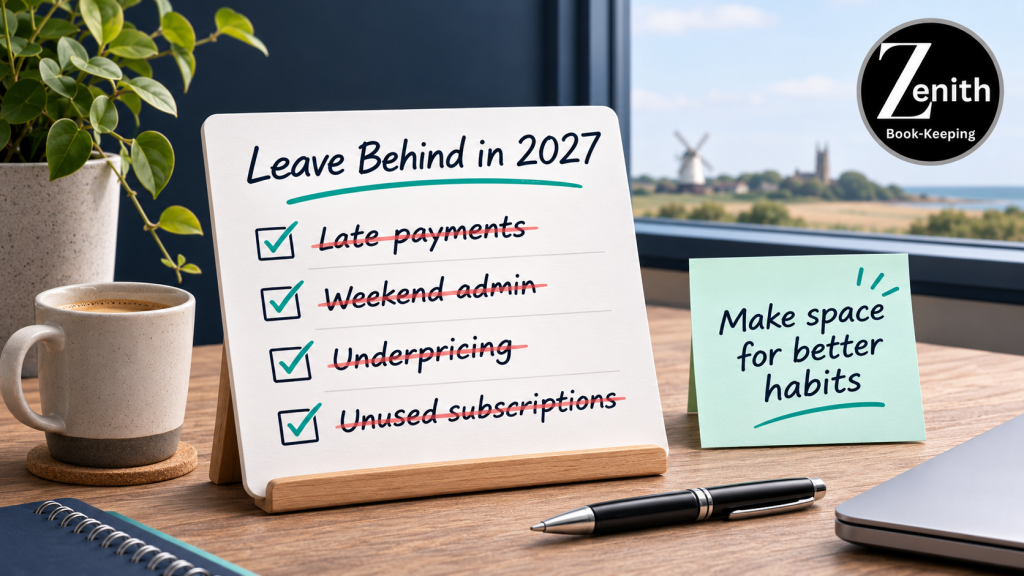
Stop accepting work at prices that no longer make sense.
Stop doing bookkeeping at the weekend.
Stop tolerating customers who consistently ignore payment terms.
Or perhaps yours are completely different.
Write them down.
Then decide what needs to change to make each one possible.
Stopping something usually requires an action.
If you want to stop late invoicing, create an invoicing routine.
If you want to stop undercharging, review your prices.
If you want to stop working every evening, look at workload and margins.
That turns a good intention into something practical.
Good bookkeeping helps you know what deserves to stop
The problem with deciding purely on instinct is that the loudest problem is not always the biggest one.
Accurate records can help show:
- Which costs keep rising.
- Which customers pay slowly.
- Which services generate the most income.
- Where cash becomes tight.
- How much you are taking personally.
- Whether turnover growth is producing better profit.
That makes decisions easier.
You are not simply thinking:
“This feels expensive.”
You can see it.
Not:
“That customer seems slow to pay.”
You can check.
Good bookkeeping turns vague concerns into information.
And information makes change much easier.
A final thought: better does not always mean bigger
We live in a business culture that constantly encourages more.
More sales.
More followers.
More customers.
More turnover.
More growth.
But for the sole trader, better may be a far more useful goal than bigger.
A better business might have:
- Fewer but more profitable customers.
- Simpler systems.
- Better cash flow.
- Stronger prices.
- Less unnecessary spending.
- More predictable working hours.
- More time away from work.
So as 2027 approaches, do not ask only:
“What should I start?”
Ask:
“What am I ready to stop?”
The answer may improve your business more than another New Year’s resolution ever could.
Next in the series: Can Your Business Afford to Take Christmas Off?
Our next article will turn to something particularly relevant for sole traders as the festive break approaches.
Employees can take annual leave and continue receiving their salary.
For many self-employed people, stopping work can also mean stopping income.
We will look at how to prepare financially for a genuine Christmas break, from outstanding invoices and January bills to cash reserves and tax-pot protection.
Because taking time off should not mean spending the whole break worrying about the business.
Want to make 2027 simpler, clearer and easier to control?
If you are a sole trader or small-business owner in Norfolk and your finances have become harder to keep on top of than they should be, give Zenith Bookkeeping a call.
Zenith can help you bring your records up to date, understand what is really happening behind the numbers and create a more regular bookkeeping routine for the year ahead.
Straightforward support.
Plain English.
And clearer information to help you decide what deserves more of your attention — and what you can finally leave behind.
Call Zenith Bookkeeping today and start 2027 with fewer financial loose ends and greater clarity about your business.
This article provides general information and should not be treated as individual accounting, tax or financial advice. Your circumstances may differ, so obtain appropriately qualified advice where necessary.