Why turnover alone cannot tell you whether your business really moved forward
If you’re anything like me, at some point over the next few weeks, you’ll probably ask:
“How has business been this year?”
And the answer may come automatically.
“Busy.”
“Not bad.”
“Better than last year.”
“Turnover was up.”
But none of those answers necessarily tells you whether 2026 was actually a good year.
In our previous article, “Before You Switch Off: Give Your Business an End-of-Year MOT”, we suggested taking a little time before the festive break to look back at what worked, what caused unnecessary stress and what might need changing before 2027 begins.
This time, I want to take that idea one step further.
Because judging a year properly means looking beyond sales.
A good year might mean more profit.
But it might also mean better customers.
More predictable cash flow.
Less time spent chasing money.
A stronger reserve.
Fewer evenings spent doing paperwork.
Or simply feeling more in control of the business than you did 12 months ago.
So before you decide whether 2026 was a success, ask a wider question:
What did your business actually give you this year?
Start with turnover, but do not stop there
Turnover is an obvious place to begin.
Did you sell more in 2026 than in 2025?
If the answer is yes, that may well be positive.
But turnover only tells you how much you sold.
It does not tell you:
- What it cost to generate those sales.
- How much profit remained.
- How quickly customers paid.
- How much you personally took from the business.
- Whether the extra work created more pressure.
- Whether you had to work considerably longer hours to achieve it.
Imagine turnover increased from £60,000 to £75,000.
That sounds like a successful year.
But what if costs rose by £12,000 and you had to work most weekends to generate the additional £15,000 of sales?
The picture is now less clear.
Growth should be judged by what remains, not just by what passes through the business.
Did you make more profit?
This is the next question.
Profit is not the same as turnover, nor is it the same as your bank balance.
But it gives you a much better indication of whether the business model is working.
Compare 2026 with the previous year.
Did profit:
- Increase?
- Stay broadly the same?
- Fall despite higher turnover?
If profit fell while sales increased, look for the reason.
Perhaps:
- Supplier costs increased.
- Prices did not keep pace.
- You discounted more.
- You spent more on subcontractors.
- Travel costs increased.
- Customers demanded more uncharged work.
- Overheads quietly crept upwards.
You do not need to panic if the answer is not what you hoped.
You need to understand why.
That is what good financial information is for.
How much did you actually take from the business?
For sole traders, there is another important measure.
What did the business provide for you personally?
You may have made a healthy profit but taken very little because you were building reserves or investing heavily.
That may be entirely deliberate.
Or perhaps you took more than usual because household costs increased.
Again, the question is not whether one answer is automatically right or wrong.
It is whether the outcome matches what you expected.
Ask:
Did the business give me the income I needed this year?
If not, was that because:
- Was profit too low?
- Too much money remained tied up in unpaid invoices?
- Were costs too high?
- Tax took you by surprise?
- You invested heavily?
- You simply did not know what was safe to withdraw?
A business can look successful from the outside while its owner quietly struggles to take a reasonable income.
That deserves attention.
Did the bank balance become stronger?
Cash matters.
You may have had a profitable year but finished it with very little financial breathing room.
So compare where you stand now with where you stood at the beginning of the year.
Do you have:
- More cash available?
- A better tax reserve?
- A business buffer?
- Less reliance on credit cards or overdrafts?
- Fewer overdue customer invoices?
If yes, the business may be becoming more resilient.
That matters.
A stronger cash position gives you options.
It lets you cope with a quiet month, an unexpected bill or a late-paying customer without immediately feeling under pressure.
Were customers better?
This is one of the most useful questions we have explored this year.
Did you improve the quality of your customer base?
Perhaps you:
- Won more repeat work.
- Attracted customers who pay promptly.
- Reduced dependence on one large client.
- Increased prices for difficult work.
- Stopped working with customers who consumed too much time.
- Generated more referrals.
That may be more important than simply adding another £10,000 of turnover.
The healthiest business is not always the one with the most customers.
It may be the one with the right customers.
Did you spend less time chasing?
Late payment has been a recurring theme throughout this series.
Think back to January.
How much time did you spend wondering who had paid?
How often did you check the bank account?
How many evenings were interrupted by thoughts about overdue invoices?
Compare that with today.
If you now have:
- Clearer payment terms.
- Better invoicing.
- A regular chasing routine.
- More reliable customers.
- Better visibility of what is outstanding.
Then 2026 may have been a very good year indeed.
Not because turnover exploded.
Because the business became easier to manage.
Did you get your evenings back?
This may be the least traditional measure of business performance.
It may also be one of the most important.
How often did work spill into your evenings or weekends this year?
There will always be busy periods.
Running a business occasionally requires flexibility.
But if every evening became an extension of the working day, ask why.
Was it:
- Too much work?
- Poor pricing?
- Inefficient systems?
- Admin being left until the end of the day?
- Too much unpaid customer support?
- Not enough help?
- Trying to do everything yourself?
If the business made more money but consumed significantly more of your life, you need to decide whether that is the kind of growth you want.
Success should not automatically mean becoming permanently busier.
Did you become less dependent on yourself?
This sounds strange for a sole trader.
You are the business.
But even a one-person business can become less dependent on everything being stored in the owner’s head.
Perhaps this year you introduced:
- Better bookkeeping software.
- Automatic invoice reminders.
- Templates.
- Checklists.
- Regular financial reviews.
- Clearer customer processes.
- Better record keeping.
These things may appear small.
But they make the business more organised and less mentally demanding.
You spend less time remembering.
Less time searching.
Less time fixing things that could have been prevented.
That is real progress.
Did you make better decisions?
This may be the ultimate test.
Think about some of the decisions you made in 2026.
Did you:
- Say no to work that was badly priced?
- Ask for a deposit?
- Increase a price?
- Stop an unnecessary subscription?
- Chase a payment sooner?
- Build a reserve?
- Choose a better customer over a bigger one?
- Take a holiday because you had planned the cash flow?
None of those decisions may appear on a sales graph.
But collectively they can create a much stronger business.
Financial control is not about knowing numbers for their own sake.
It is about using them to make better decisions.
What did your business cost you personally?
There is another side to the review.
What did 2026 take from you?
Perhaps:
- Too many weekends.
- Constant worry about money.
- Missed family time.
- Holidays that never really felt like holidays.
- Stress caused by one particular customer.
- Too much time doing work you no longer enjoy.
Again, this does not automatically mean the year was bad.
Sometimes a demanding year is necessary to build something stronger.
But it should be deliberate.
If the business repeatedly takes more than it gives, something eventually has to change.
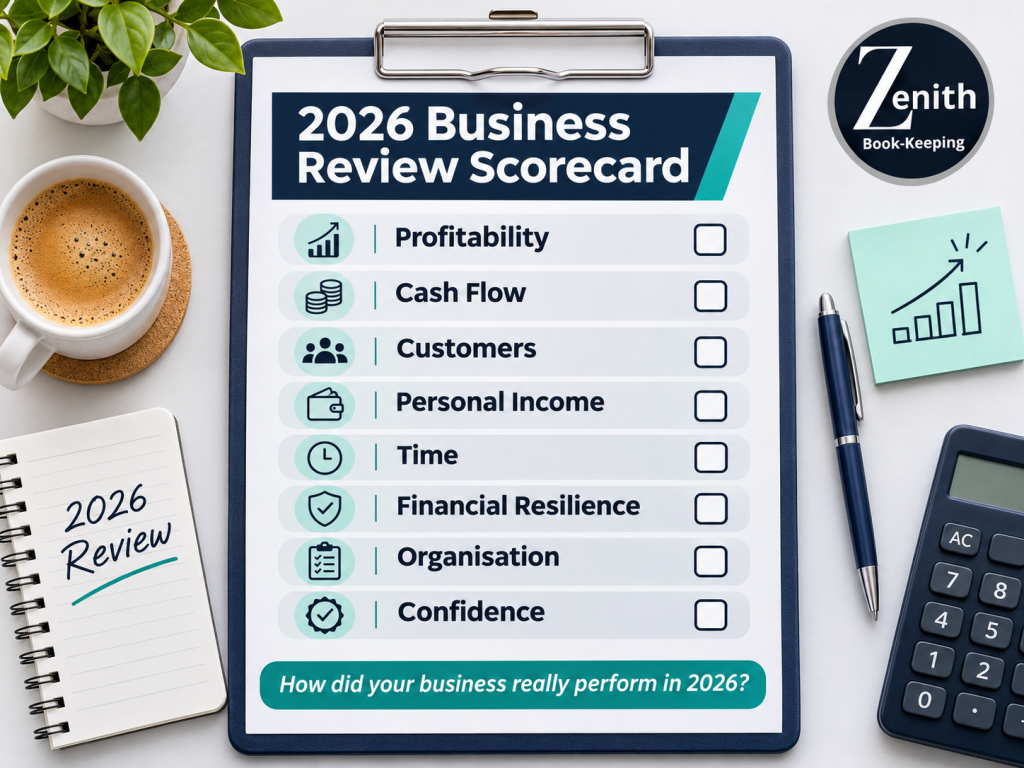
A simple 2026 scorecard
Try scoring your year from 1 to 5 in these areas:
Profitability
Did the business make enough?
Cash flow
Did money arrive when you needed it?
Customers
Would you happily work with more customers like the ones you have?
Personal income
Did the business support you adequately?
Time
Did you have enough control over your working hours?
Financial resilience
Could you cope with a quiet month?
Organisation
Are the records, invoices and admin more under control?
Confidence
Do you understand your numbers better than you did a year ago?
You are not trying to produce a perfect scientific score.
You are trying to see the whole business.
A year with slightly lower turnover but much stronger scores elsewhere might actually represent significant progress.
Then ask one more question
If 2027 looked exactly like 2026, would you be happy?
That question can be revealing.
If your immediate reaction is:
“Yes, absolutely.”
then you have built something worth protecting.
If the answer is:
“Mostly — but I would change a few things.”
you have just identified your priorities for next year.
And if your reaction is:
“No. I cannot do another year like that.”
then that deserves your attention before January begins.
Good bookkeeping helps you answer the question properly
Without current records, an annual review is mostly a matter of memory.
And memory tends to focus on extremes.
The terrible month.
The brilliant customer.
The huge invoice.
The expensive repair.
Regular bookkeeping gives you a more balanced picture.
It can help you see:
- What you actually earned.
- What you spent.
- How profit changed.
- Which customers still owe money.
- How costs developed.
- What you took personally.
- Where money became tied up.
- Whether the business became stronger financially.
That is why bookkeeping should never be treated simply as something done for HMRC.
Good records help you understand the business you are actually running.
So — was 2026 a good year?
Perhaps the answer is yes.
Perhaps it is mixed.
Perhaps some things improved while others became harder.
That is normal.
The important thing is to understand why.
Do not judge the entire year on one number.
Look at the money.
Look at your customers.
Look at your time.
Look at the level of stress.
Look at the resilience you have built.
And look at whether you feel more or less in control than you did 12 months ago.
That gives you a much better definition of progress.
Next in the series: What Should You Stop Doing in 2027?
In our next article, we will turn the usual New Year planning exercise on its head.
Instead of asking what else you should add to your already busy business, we will ask:
What should you stop doing?
The wrong customers.
Unprofitable work.
Unused subscriptions.
Poor habits.
Unnecessary admin.
Because sometimes the quickest route to a better business is not adding another goal.
It is removing something that no longer belongs.
Want a clearer picture before 2027 begins?
If you are a sole trader or small-business owner in Norfolk and are not entirely sure how 2026 went, give Zenith Bookkeeping a call.
Clear, up-to-date records can help you see beyond the bank balance and understand what the year actually delivered — your income, costs, cash flow, outstanding invoices and overall financial position.
That means you can start 2027 with fewer assumptions and better information.
Call Zenith Bookkeeping today and give yourself a clearer view of the business you are taking into 2027.
This article provides general information and should not be treated as individual accounting, tax or financial advice. Your circumstances may differ, so obtain appropriately qualified advice where necessary.