(and Why It’s Not Just About Money)
If you’re a sole trader, it’s completely normal to do your own bookkeeping at the start.
You’re trying to keep costs down. You want to stay in control. And let’s be honest — it feels like something you should be able to handle.
But for many small business owners, “doing the books” quietly becomes one of the biggest drains on time, energy, and confidence.
Not because you’re incapable — but because bookkeeping isn’t just a task. It’s a system. And when you’re running a business, the hidden cost of trying to manage that system alone often shows up in places you feel every day.
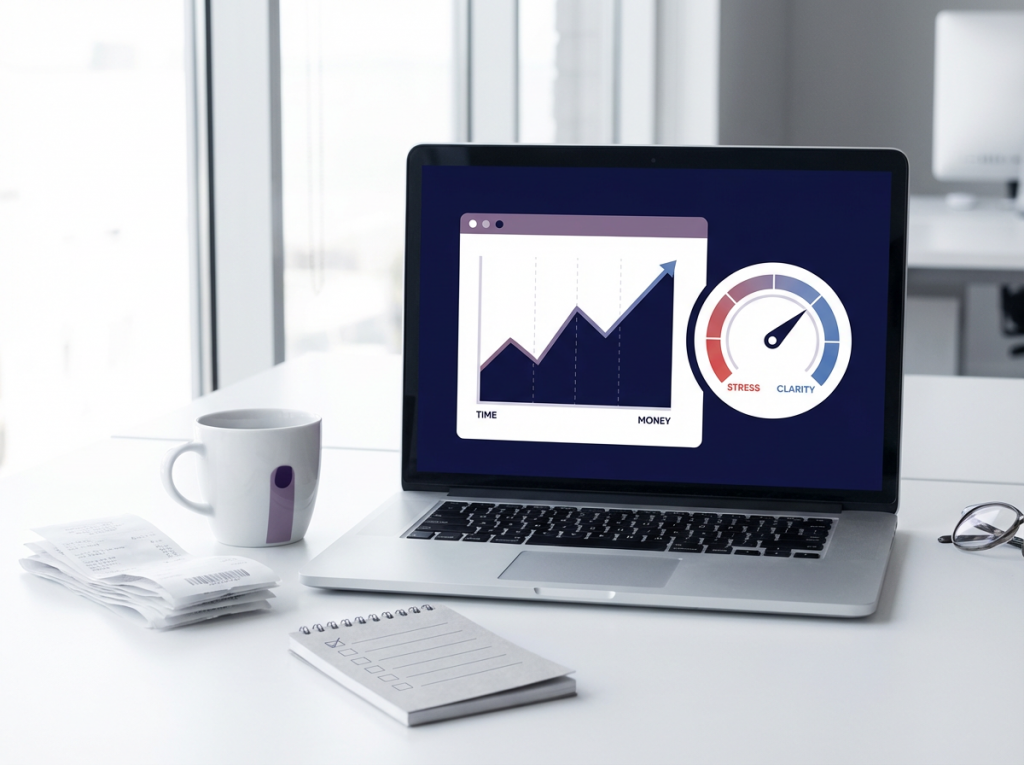
This article breaks down the real cost of DIY bookkeeping (beyond the pounds and pence) and explains how a bookkeeping service can act as a pressure-release valve — giving you clarity, not just compliance.
The myth: “I’m saving money by doing it myself”
DIY bookkeeping can look like a saving on paper. If you don’t pay a bookkeeper, you keep that money in the business.
But the real question is:
What is it costing you in time, headspace, missed opportunities, and avoidable stress?
Because most sole traders don’t do their books in a neat two-hour block on a Tuesday morning.
They do it:
- late at night after a full day of work
- on weekends when they should be resting
- in rushed bursts when a deadline is looming
That’s where the hidden cost starts.
Hidden cost: Time leakage (evenings, weekends, and “just one more hour”)
Bookkeeping rarely stays contained.
It’s not just entering a few numbers. It’s:
- finding receipts
- matching transactions
- working out what something was for
- chasing invoices
- untangling personal vs business spending
- trying to remember what happened three months ago
Even if you only spend 2–3 hours a month, it often comes out of your personal time — and it rarely feels finished.
A quick reality check
Ask yourself:
- Do I put bookkeeping off because it feels like a mental load?
- Does it spill into evenings or weekends?
- Do I lose time searching for receipts or bank transactions?
If yes, you’re not alone. This is exactly what happens when bookkeeping lacks a simple system.
Hidden cost: Headspace (the mental tab that never closes)
One of the highest costs of DIY bookkeeping is the constant background noise:
- “I really need to catch up on my receipts.”
- “I hope I’ve set aside enough for tax.”
- “What if I’ve done something wrong?”
- “I’ll deal with it later.”
That mental load affects your ability to switch off.
And when you’re self-employed, switching off isn’t a luxury — it’s how you stay sharp, motivated, and able to serve clients well.
Hidden cost: Stress around HMRC letters and deadlines
Most sole traders don’t fear tax because they’re doing something dodgy.
They fear it because they’re not 100% sure their records are right.
So when a letter lands from HMRC, it can trigger instant stress — even if it’s routine.
Deadlines can feel like a countdown.
And the worst part is the uncertainty:
“Have I missed something?”
A good bookkeeping setup reduces that fear because you’re not relying on memory or last-minute catch-up.
Hidden cost: Missed allowable expenses (and paying more tax than you need to)
This is one of the most common DIY bookkeeping issues.
When you’re busy, it’s easy to miss:
- small subscriptions
- mileage
- bank fees
- home working costs
- phone/internet business use
- tools and consumables
Individually, they don’t look like much.
But across a year, missed expenses can add up — and that can mean you pay more tax than necessary.
It’s not about “claiming everything.” It’s about claiming what’s legitimate, evidence-based, and clearly business-related.
Hidden cost: Poor cash visibility (the “where did the money go?” problem)
A lot of sole traders are working hard, invoicing, and staying busy — yet still feel unsure about their finances.
That’s usually because they don’t have clear visibility on:
- What’s coming in
- What’s going out
- What’s left after overheads
- What needs to be set aside for tax
Without that clarity, you can end up making decisions based on gut feel:
- delaying investment because you’re unsure
- underpaying yourself
- underpricing because you don’t know your true costs
- saying yes to work that isn’t profitable
Bookkeeping isn’t just admin — it’s the foundation of confident decision-making.
Hidden cost: Opportunity cost (what you could be doing instead)
This is the big one.
Every hour you spend wrestling with your books is an hour you’re not spending on:
- delivering paid work
- marketing and lead generation
- following up enquiries
- improving your service
- raising your prices with confidence
- building partnerships
Even if bookkeeping only takes a few hours a month, those hours often come at the exact time you should be doing the work that grows the business.
What a bookkeeping service really gives you (it’s not just compliance)
A good bookkeeper doesn’t just “do your books.”
They give you:
- clarity: you know where you stand
- consistency: you’re not always catching up
- confidence: you stop second-guessing
- time back: evenings and weekends feel like yours again
- better decisions: pricing, spending, tax set-aside, and growth become simpler
In other words, it’s a pressure-release valve.
What it looks like in practice (simple, not complicated)
For most sole traders, getting support doesn’t mean turning your business upside down.
It usually means:
- A quick review of how you currently track things (bank, receipts, invoices)
- A simple setup that fits your business (and any software you already use)
- A light routine so you stay up to date without the stress
If you already use bookkeeping software, Zenith Book Keeping can help you get the best from it. If you don’t, they’ll guide you through the best options so your record-keeping and planning become as easy as 1-2-3.
Takeaways (save these)
- DIY bookkeeping often costs more than money — it costs time, headspace, and confidence
- The stress usually comes from uncertainty, not the numbers themselves
- Missed expenses and poor visibility can quietly reduce profit
- The highest cost is often opportunity cost: time not spent on sales or delivery
- A bookkeeping service is a pressure-release valve that gives clarity, not just compliance
Ready to take the pressure off?
If you’re doing your own books and it’s starting to feel heavier than it should, you don’t have to keep pushing through.
Zenith Book Keeping is happy to offer a no-obligation one-to-one chat to look at where you are now, what you’re currently using (if anything), and what would make your bookkeeping and planning simpler.
No judgement. No pressure. Just practical help.
Reach out to Zenith Book Keeping to book your no-obligation one-to-one and take the first step toward clearer, calmer finances.