
How Simple Bookkeeping Keeps New Ventures Alive (and Thriving)
Starting out as a sole trader, contractor, or self-employed micro business owner is exciting. You can experience the highest highs and the lowest lows in the same day. It can also be messy.
In the early years, it would be fair to say you’re at your most vulnerable. This is what I call the danger zone: that stretch of time where you’re building momentum, wearing every hat, and trying to keep customers happy—while the “boring business stuff” quietly stacks up in the background.
And here’s the uncomfortable truth: most self-employed people don’t struggle because they lack talent or work ethic. They struggle because the foundations aren’t solid—especially when it comes to money.
Why the early years feel so hard (when it’s just you)
When you’re self-employed, your days are packed with:
- Finding clients
- Delivering great work
- Marketing yourself
- Quoting and invoicing
- Chasing payments
- Learning as you go
So it’s no surprise that bookkeeping gets pushed down the list.
The problem is: bookkeeping doesn’t stay small. It compounds. And when it catches up, it usually does so at the worst possible moment—right when you’re already stretched.
Case study: Alison (freelancer)
Alison started with a skill she already had, a service she believed in, and a real passion for the work.
It wasn’t long before she got her first customers. The high of landing work was intoxicating. Then the money started to come in, and things felt good.
But reality started to reveal itself.
At first, it was just a nagging feeling. Then it became impossible to ignore:
- Receipts were piling up
- She wasn’t sure what she could claim as expenses
- Tax deadlines were creeping closer
- Cash flow started to feel unpredictable
- She kept wondering if she was actually making money
Eventually, Alison realised “I’ll sort this later” wasn’t viable.
Bookkeeping wasn’t an optional extra—it was a foundation she’d neglected.
The real cost of “I’ll sort it later”
Alison’s story is common because it’s human. When you’re busy, you prioritise what feels urgent.
But when bookkeeping is left too long, it creates hidden risks:
- You lose visibility. You can’t confidently answer: “Am I actually making money?”
- You lose time. Catching up later takes far longer than doing it little and often.
- You lose options. Without clear numbers, it’s harder to price properly, plan ahead, or invest.
- You lose sleep. Deadlines and uncertainty create stress that bleeds into everything.
The danger zone isn’t about fear—it’s about fragility. A business can look successful on the outside while the finances are quietly becoming chaotic.
The good news: bookkeeping can be simple (and even empowering)
Bookkeeping has a reputation for being confusing, technical, and time-consuming.
In reality, good bookkeeping is mostly about:
- A clear system
- A repeatable routine
- Plain-English understanding of what matters
Once those pieces are in place, it stops being a dreaded task and starts becoming a tool.
Because when you know your numbers, you can:
- Make decisions faster
- Spot problems earlier
- Plan with confidence
- Feel in control (even when business is busy)
A foundation you can keep, even when you’re busy
If you recognise yourself in Alison’s story—receipts piling up, uncertainty about expenses, deadlines creeping closer—you’re not alone.
And you don’t need to become an accountant to fix it.
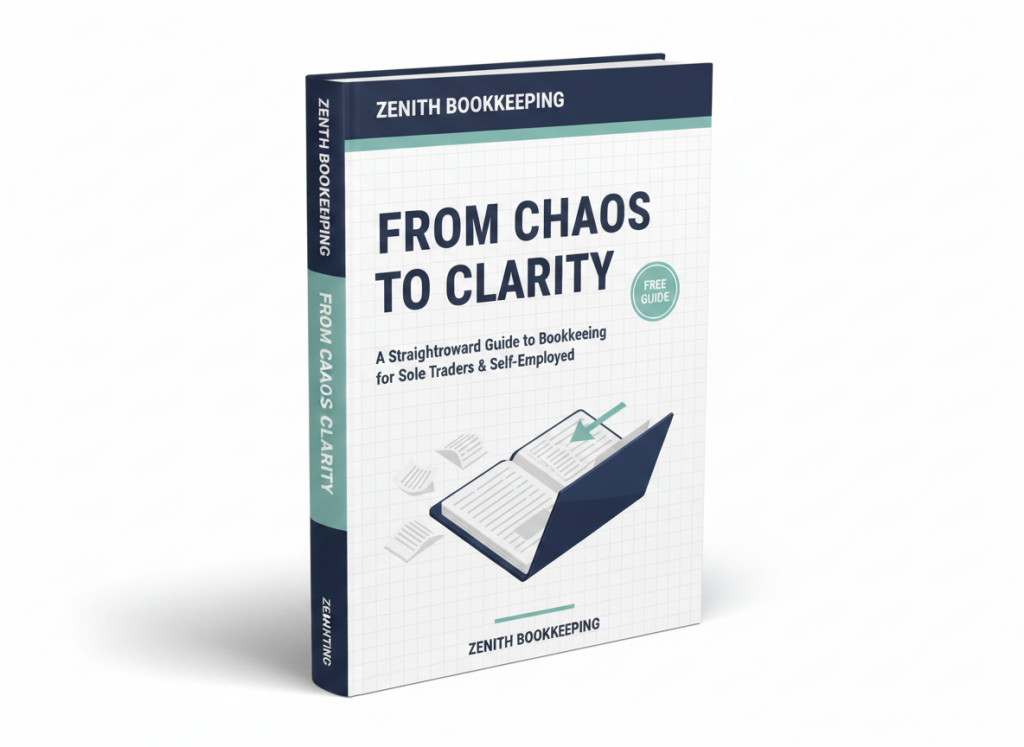
That’s exactly why this book was created: to help sole traders and contractors avoid the danger zone by helping you:
- Understand bookkeeping in plain English
- Avoid common mistakes
- Take control of your finances
- Build a routine you can keep, even when you’re busy
Ready to get out of the danger zone?
If you’re serious about building a business that lasts, start with the foundations.
The sooner you put a simple bookkeeping routine in place, the sooner you’ll feel the difference—in clarity, confidence, and calm.
You can find the book offer here: https://zenithbook-keeping.uk/zenith-bookkeeping-book-offer-page