
How to Protect Your Cash Flow Without Damaging Good Customer Relationships
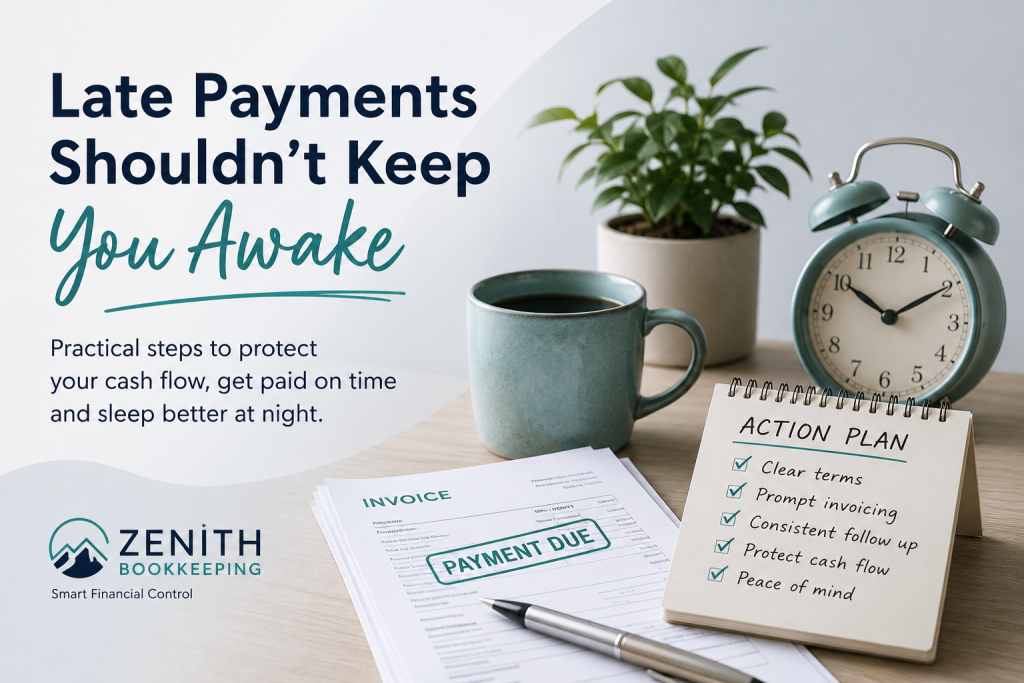
You have done the work. The invoice has been sent. The payment date has passed. And now, at 11 o’clock at night, you are thinking about somebody else’s bank account.
Will they pay tomorrow?
Did they forget?
Should you chase them again?
Are they having financial problems?
Will asking too firmly damage the relationship?
And, perhaps most importantly:
Can you still pay everything you need to pay if they don’t?
Does this sound a little familiar? Late payment has a habit of following small-business owners home.
In our previous article, “Stop Chasing Money in Your Head”, we looked at how unpaid invoices create unfinished loops; those nagging financial questions that remain in the background long after the working day has ended.
This time, we want to go a little further.
Although you cannot force every customer to pay on time, you can create a business that is much less vulnerable when someone does not.
That means looking at late payment before the invoice becomes overdue, recognising warning signs earlier, building a consistent recovery process and understanding when being patient stops being good customer service and starts becoming a risk to your own business.
Late payments may be common.
But they should not keep you awake.
Late payment is bigger than one awkward invoice
Late payment remains a significant problem for UK businesses.
Recent government research estimates that around £26 billion is owed to UK businesses in late payments at any one time, with affected businesses spending an average of 86 hours a year chasing overdue invoices. More than 1.5 million businesses are estimated to be affected each year.
For a large organisation, one overdue invoice may be inconvenient.
For a sole trader or small business, it can be much more serious.
The money you are waiting for may already have a job.
It may be needed to:
- Pay a supplier.
- Cover wages or subcontractors.
- Pay VAT or tax.
- Replace materials.
- Meet rent or vehicle costs.
- Fund the next job.
- Pay yourself.
This is why late payment is not simply a bookkeeping issue.
It is a cash-flow issue. And cash flow is what keeps an otherwise profitable business operating. You can have plenty of work, good customers and a healthy order book and still experience serious pressure if the money does not arrive when expected.
Prevention starts before you do the work
One of the most effective ways to deal with late payment is to stop treating payment as something that only becomes important after the work has been completed.
Payment arrangements should be part of the agreement from the beginning. Before starting significant work, make sure both sides understand:
- What you are supplying.
- What it will cost.
- When you will invoice.
- When payment will be due.
- How payment should be made.
- Whether a deposit is required.
- Whether staged payments will apply.
- What happens if the scope changes.
- Who is responsible for approving payment.
If you are supplying another business, also establish whether they require:
- A purchase order number.
- A supplier-registration process.
- A particular invoice format.
- Invoices sent to a specific accounts email address.
- Supporting documents or timesheets.
- Approval from a named person.
These details can feel administrative when you are eager to start the work. But discovering after completion that your invoice cannot be processed because you do not have the correct purchase order can add weeks to the payment cycle.
A ten-minute conversation at the beginning may save a month of chasing later.
Be careful who you give credit to
When you allow someone to pay after the work is completed, you are effectively giving them credit.
That is easy to forget.
You have provided the labour, materials, expertise or product. They have not yet provided the money. For established customers with a reliable payment history, that may be perfectly reasonable. For a new customer, particularly on a large job, it may deserve more thought.
Consider asking:
- How long has the business been operating?
- Is this a much larger order than usual?
- Why are they asking for extended terms?
- Have you checked basic company information?
- Do other suppliers have experience of working with them?
- Would a deposit reduce your exposure?
- Could the project be invoiced in stages?
You do not need to become suspicious of every new customer.
You do need to remember that winning work and getting paid for work are not the same thing.
A £10,000 order is not necessarily a £10,000 success if you have to spend months collecting it.
Deposits are not a sign of distrust
Some sole traders hesitate to ask for deposits because they worry it makes them appear difficult.
Often the opposite is true.
A clear deposit structure can make the commercial relationship more professional.
Depending on the nature of the work, you might use:
- A percentage before work begins.
- Payment for materials in advance.
- A booking fee.
- Staged payments at agreed milestones.
- Monthly billing on longer projects.
- Full payment before delivery for certain products or services.
A deposit does several things.
It confirms commitment.
It reduces the amount you fund on the customer’s behalf.
And it means that if something goes wrong later, the entire value of the job is not outstanding.
The right arrangement will depend on your business, customer and contract, but the principle is simple:
The more money you have at risk, the more carefully the payment structure should be considered.
Invoice promptly
There is an interesting contradiction in many small businesses.
Owners become frustrated when customers take 30 days to pay, yet sometimes wait two weeks themselves before sending the invoice.
If you finish a job on the first of the month but do not invoice until the fifteenth, you have already extended the payment period by two weeks.
Where possible, invoice as soon as the agreed billing point is reached.
That may mean:
- Immediately after completing the work.
- At an agreed project milestone.
- On the same day each week.
- At the end of each agreed monthly period.
Do not allow invoicing to become the task you do “when you get a chance”.
Getting paid is part of delivering the work.
It deserves a place in the normal working routine.
Make the invoice impossible to misunderstand
A good invoice should answer the customer’s basic questions immediately.
Who is this from?
What is it for?
How much do I owe?
When is payment due?
How do I pay?
Before sending an invoice, check that it contains the correct:
- Business and customer details.
- Invoice number.
- Invoice date.
- Description of goods or services.
- Amount due.
- VAT details, where applicable.
- Payment terms.
- Due date.
- Bank details.
- Purchase order or reference number, if required.
An incomplete invoice provides an easy reason for delay.
The Office of the Small Business Commissioner specifically recommends checking payment terms, invoice accuracy and payment information when dealing with unpaid invoices.
The aim is to remove friction. Make paying you easier than postponing the problem.
Give the customer a clear due date
“Payment terms: 30 days” can sometimes create unnecessary ambiguity.
Thirty days from when?
The work being completed?
The invoice being issued?
The invoice entering the customer’s system?
Where possible, include an actual due date:
Payment due: 14 September 2026
That gives everybody one clear reference point.
It also makes your own bookkeeping easier because your system can identify the moment the invoice becomes overdue.
Under the current rules for business-to-business transactions, if a payment date is agreed, it must usually be within 60 days, although longer terms can be agreed where they are fair to both businesses. If no date has been agreed, a commercial payment will generally become late 30 days after the customer receives the invoice or the goods or services are provided, whichever is later.
Do not wait until an invoice is seriously overdue
One of the easiest mistakes is being too polite for too long.
The payment date passes.
You wait three days.
Then a week.
Then perhaps another week because you do not want to appear pushy.
By the time you contact the customer, the invoice is already significantly overdue.
A better system begins earlier.
For important invoices, a short message shortly before the due date can help:
Just checking that invoice 1284, due on Friday, has everything you need for payment. Please let me know if there are any queries.
That message does not accuse anybody of paying late. It identifies problems before the deadline.
Perhaps the invoice was never received. Perhaps the person who approved it is away. Perhaps the purchase-order number is wrong. Perhaps it has already been scheduled for payment.
You now know.
Create an escalation ladder
Late-payment chasing becomes stressful when there is no predetermined next step.
You send one email.
Nothing happens.
You send another.
Still nothing.
Then you start wondering what to do.
Instead, create a simple escalation ladder.
Stage One — Friendly reminder
Send this immediately after the payment becomes overdue. Keep it light and professional. Assume an oversight.
Include:
- Invoice number.
- Amount.
- Due date.
- Copy of invoice.
- Payment details.
The purpose is simply to get the invoice back onto the customer’s radar.
Stage Two — Direct follow-up
If payment is still outstanding several days later, contact the customer again. This time, ask for a specific answer:
“Please can you confirm the date on which payment will be made?”
That question is much more useful than:
“Just wondering if you have had a chance to look at this?”
You are trying to establish a commitment.
Stage Three — Pick up the telephone
Emails are easy to ignore.
A short, polite conversation can resolve issues much faster.
Ask:
- Is there a problem with the invoice?
- Has it been approved?
- When is the next payment run?
- Who is responsible for authorising it?
- Is there anything preventing payment?
Take notes.
If the customer promises payment on a particular date, confirm the conversation in writing afterwards.
Stage Four — Missed promise
A promised payment date is different from an ordinary overdue invoice.
The customer has now specifically told you when payment will arrive.
If that date passes, follow up quickly.
For example:
Thank you for confirming that payment would be made by Friday. It has not yet reached our account. Please could you arrange payment today or let me know immediately if there is a problem.
Still professional.
But clearer.
Stage Five — Formal escalation
If repeated reminders and promises achieve nothing, the tone needs to change.
At this stage you may need to:
- Send a formal demand.
- Apply contractual or statutory interest where appropriate.
- Claim eligible recovery costs.
- Pause further work.
- Seek assistance from the Small Business Commissioner where applicable.
- Obtain professional debt-recovery or legal advice.
- Consider court action.
The important point is that the customer sees a progression. An invoice cannot remain indefinitely in the “friendly reminder” stage.
Know when a payment plan makes sense
Sometimes the customer does not dispute the debt. They simply do not have enough money to pay it immediately.
You then have a commercial decision to make. You could insist on full payment. Or you may decide that receiving the debt through an agreed instalment plan is better than receiving nothing while the situation deteriorates.
If you agree a payment plan, put it in writing.
State:
- The total outstanding balance.
- Each instalment amount.
- Each payment date.
- The method of payment.
- Whether interest or charges apply.
- What happens if an instalment is missed.
- Whether further work will be provided meanwhile.
Avoid vague arrangements such as:
“Pay what you can over the next couple of months.”
That simply replaces one uncertain debt with several uncertain payments. A proper payment plan creates new, measurable commitments.
The Small Business Commissioner also identifies documented instalment arrangements as one possible approach where a customer is experiencing genuine cash-flow difficulty.
Do not keep supplying somebody who is not paying
This can be one of the hardest decisions. The customer owes you £2,000. Then they ask you to complete another £1,500 of work.
You think:
“If I say no, maybe I’ll lose them altogether.”
But another question deserves equal attention:
If they cannot pay the first £2,000, why would you want them to owe you £3,500?
Continuing to supply a non-paying customer increases your exposure.
Before accepting further work, consider:
- Why the existing invoice has not been paid.
- Whether previous promises have been kept.
- Whether the customer is communicating openly.
- Whether a deposit can be required.
- Whether existing debt should be cleared first.
- Whether the relationship is still commercially sensible.
Sales figures can flatter a business.
Cash tells the truth.
Work that remains unpaid does not pay your own bills.
Watch for patterns, not just individual invoices
One late invoice may be an accident. Repeated late payment is a behaviour. Good bookkeeping allows you to identify patterns.
For example:
- Customer A always pays within 14 days.
- Customer B usually pays seven days late.
- Customer C repeatedly promises payment and misses the date.
- Customer D disputes invoices only after they become overdue.
- Customer E has gone from paying promptly to paying increasingly slowly.
Those patterns are valuable.
They allow you to change how you work with the customer.
You might decide to:
- Shorten credit terms.
- Request a deposit.
- Move to payment in advance.
- Reduce the amount of credit offered.
- Invoice more frequently.
- Stop supplying altogether.
Customer behaviour should influence payment terms.
Good customers earn trust.
Poor payment history should change the level of risk you are willing to accept.
Protect yourself from customer concentration
Late payment becomes particularly dangerous when too much of your income depends on one customer.
Imagine that one client provides 60% of your monthly income. If they pay two weeks late, your entire cash position may be disrupted. If they stop paying altogether, the business could suddenly face a serious problem.
This is called customer concentration risk.
Ask yourself:
If my largest customer paid me 30 days late, could the business cope?
Then ask:
If they disappeared completely, what would happen?
You do not necessarily need to stop working with a valuable large customer.
But you should understand the risk.
You might respond by:
- Building a larger cash reserve.
- Negotiating better payment terms.
- Taking deposits.
- Invoicing more frequently.
- Developing other customers so income is less concentrated.
The goal is to prevent one customer’s payment behaviour from keeping you from sleeping at night.
Build a cash buffer
Even with excellent systems, not every invoice will arrive exactly when expected.
That is why a cash reserve matters.
Think of it as financial shock absorption.
A buffer gives you more time to respond if:
- A major customer pays late.
- Sales fall unexpectedly.
- Equipment breaks.
- A supplier needs paying before expected.
- A customer becomes insolvent.
- Several invoices are delayed at once.
The appropriate amount depends on your business.
But even a modest reserve can change the conversation.
Without a buffer:
“If they don’t pay Friday, I can’t pay the supplier Monday.”
With a buffer:
“They are late. I need to chase them, but the business can still operate.”
That is a very different level of pressure.
Understand your rights
If another business pays late for goods or services, current UK rules may allow you to claim statutory interest and debt-recovery costs.
Statutory interest is currently calculated at 8% above the Bank of England base rate for qualifying business-to-business debts, unless the contract provides a different substantial remedy.
Eligible suppliers may also claim a fixed recovery amount for each qualifying late payment:
- £40 for debts up to £999.99.
- £70 for debts between £1,000 and £9,999.99.
- £100 for debts of £10,000 or more.
Knowing that these rights exist does not mean you have to apply interest to every customer who pays one day late.
There is still a commercial relationship to manage.
But knowing your position gives you options when repeated informal chasing is getting nowhere.
Changes are coming, but do not assume they are already law
Late payment has become an increasingly prominent issue for government.
The Commercial Payments Bill, introduced to Parliament in May 2026, proposes significant changes, including maximum 60-day payment terms in many business transactions, mandatory late-payment interest and stronger powers for the Small Business Commissioner.
These proposals are important, but at the time of writing they should not be confused with the rules already in force.
The government has confirmed that there will be a lead-in period before the new measures take effect and that they will not apply retrospectively.
For now, businesses should continue to follow the current rules while keeping an eye on changes as the legislation progresses.
When the Small Business Commissioner may help
If you are a small business experiencing an unresolved payment problem with a larger private-sector customer, the Office of the Small Business Commissioner may be able to provide support.
The Commissioner can provide advice and currently investigates qualifying complaints about late and overdue payments.
The service may be particularly useful before legal action begins. The Commissioner specifically advises businesses to consider approaching its office before starting court proceedings because its ability to assist can change once legal action has begun.
Again, this is not about threatening every late-paying customer with formal action.
It is about knowing that you do not necessarily have to deal with serious payment problems alone.
Know when it is time to get professional help
Some debts go beyond ordinary credit control.
Get appropriate advice if:
- The amount is substantial.
- The customer disputes liability.
- The customer appears insolvent.
- The business has ceased trading.
- You are considering legal proceedings.
- You are unsure whether interest or charges apply.
- The customer alleges that you have breached the contract.
- There are several connected invoices or contractual issues.
The longer a serious debt remains unresolved, the more important it becomes to understand your options.
Persistence is useful.
So is knowing when the problem requires somebody with specialist expertise.
Where a good bookkeeper fits in
A bookkeeper cannot make an unreliable customer become reliable.
But good bookkeeping can dramatically improve your ability to manage the risk.
At Zenith Bookkeeping, effective bookkeeping is not simply about recording what has already happened.
It should help give you a clearer view of what needs attention now.
That may include:
- Keeping invoices accurately recorded.
- Reconciling payments quickly.
- Identifying overdue balances.
- Producing aged-debtor information.
- Spotting customers whose payment times are getting longer.
- Helping establish regular invoicing routines.
- Providing clearer cash-flow information.
- Making it easier to separate money owed from money actually available.
- Helping you prepare information if a debt needs escalating.
When you know what is outstanding and what action has already been taken, late payment becomes easier to manage systematically.
And once it becomes a system, you no longer need to hold the entire problem in your head.
A practical late-payment check for this week
You do not need to redesign your complete credit-control process overnight.
Start with these seven actions.
1. Look at every outstanding invoice
Do you know exactly:
- Who owes you?
- How much?
- When it was due?
- What you last did about it?
If not, create one list.
2. Identify anything already overdue
Do not leave it until next week.
Send the first reminder now.
3. Check your invoice template
Make sure the due date and payment details are obvious.
4. Review your customer terms
Ask whether your current payment terms make sense for the level of risk you are taking.
5. Decide your chasing timetable
Write down what happens:
- Before the due date.
- One day overdue.
- Seven days overdue.
- Fourteen days overdue.
- After a broken payment promise.
Your timings may differ, but having a process is what matters.
6. Identify your highest-risk customer
Who owes you the most?
Who pays slowest?
Who would cause the biggest problem if payment stopped?
Understanding the risk allows you to manage it.
7. Put credit control into your diary
Choose a regular time during business hours.
Review invoices.
Send reminders.
Make calls.
Update notes.
Then stop.
Do not spend the evening checking your bank account again.
A final thought: your business is not a free bank
Good customer relationships matter. Being flexible matters. Understanding that another small business may occasionally have a difficult month matters too.
But there is a line between being understanding and financing somebody else’s business at the expense of your own.
You have already provided the work. You have already spent the time. You may already have paid for materials, staff, travel or suppliers.
Expecting the customer to honour the agreed payment date is not unreasonable.
Professional credit control does not mean becoming aggressive.
It means becoming clear.
Clear terms.
Clear invoices.
Clear reminders.
Clear escalation.
And clear decisions about how much risk you are prepared to take.
Even with those systems in place, an overdue invoice may still be irritating.
It may still require attention.
But it does not need to become the last thing you think about before you go to sleep.
Are late payments putting pressure on your cash flow?
If you are a sole trader or small-business owner in Norfolk and it is becoming difficult to keep track of invoices, overdue payments and the true cash position of your business, Zenith Bookkeeping can help.
Good bookkeeping gives you more than tidy records.
It gives you visibility.
You can see what has been invoiced, what has been paid, what is overdue and where action may be needed before a small problem becomes a serious one.
Zenith Bookkeeping provides straightforward, practical bookkeeping support in plain English, helping you stay organised, understand your numbers and keep better control of your cash flow.
Start a conversation with Zenith Bookkeeping today and build a financial routine that helps you stay on top of late payments without allowing them to take over your evenings.
This article provides general information and should not be treated as legal, financial or debt-recovery advice. Rights and appropriate recovery action depend on the contract and individual circumstances. Check current guidance and obtain professional advice where appropriate.