Why Knowing Your Break-Even Point Can Change the Way You Run Your Business
You have had a busy month. Customers have paid. Money has moved through the bank account. You have invoiced more than you did last month. So it feels as though the business must be doing well.
But there is one question that many sole traders cannot answer with confidence:
How much does your business actually need to earn before you make any profit at all?
In our previous article, “Your Bank Balance Is Not Your Profit”, we looked at why the amount sitting in your bank account does not necessarily tell you how well the business is performing.
This article takes that idea one step further.
Because before you can properly understand profit, pricing or whether the business can afford to grow, you need to understand the point at which your income has simply covered the cost of being in business.
That point is known as break-even.
And although the term may sound like something that belongs in an accounting textbook, the idea behind it is surprisingly simple.
What does break-even actually mean?
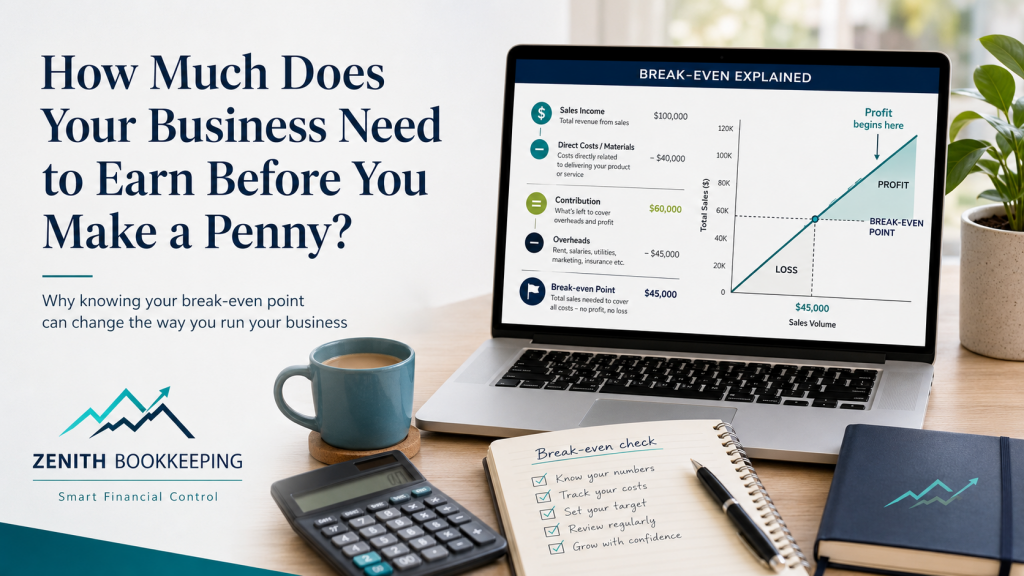
Your break-even point is the level of sales at which your business has covered its costs but has not yet made a profit.
Below that point, the business is losing money.
Above it, the business starts to generate profit.
Imagine that it costs you £3,000 a month simply to operate your business. Until your income has covered that £3,000, you have not made a profit. You may have been extremely busy. You may have raised several invoices. You may have money in the bank. But financially, the business has only reached the starting line once those costs have been covered.
Everything after that is where profit begins.
Understanding that number can completely change how you look at sales.
Busy does not always mean profitable
This can be uncomfortable to recognise. A full diary feels successful. Lots of customer enquiries feel successful. Invoices going out feel successful.
But activity and profitability are not the same thing.
You can be busy from Monday morning until Friday evening and still earn very little once all the costs involved in delivering that work are taken into account.
For example, a job may bring in £500.
That sounds positive.
But perhaps it requires:
- £120 of materials.
- £40 of fuel and travel.
- £30 of subcontractor help.
- £20 of other direct costs.
- Several hours of your own time.
That £500 sale has not produced £500 of profit.
And it also needs to contribute towards the wider costs of running your business.
Those costs exist whether that particular customer buys from you or not.
Start with the costs that keep the doors open
Every business has costs that continue regardless of how much work comes in.
These are often called fixed costs.
For a sole trader, they might include:
- Insurance.
- Software subscriptions.
- Phone and internet.
- Vehicle finance.
- Rent or workspace costs.
- Accountancy or bookkeeping.
- Professional memberships.
- Website costs.
- Finance repayments.
- Advertising commitments.
- Equipment leases.
Some of these amounts may change occasionally, but they apply whether you make 10 sales this month or none.
Add them together.
That gives you a starting point.
Suppose your regular business overheads total £1,800 each month.
Before considering anything else, the business needs to generate enough contribution from sales to cover that £1,800.
Then look at the costs created by each sale
Other expenses rise as you do more work.
These are sometimes called variable or direct costs.
They might include:
- Materials.
- Stock.
- Packaging.
- Delivery.
- Merchant fees.
- Subcontractors.
- Commission.
- Mileage directly connected with a job.
- Consumables used to provide the service.
If you sell something for £100 but it costs you £40 to provide it, only £60 remains to contribute towards your overheads and eventual profit.
That distinction matters.
You cannot simply divide your overheads by your selling price and assume you have found your break-even point.
You need to understand what each sale actually contributes after its direct costs have been covered.
A simple example
Imagine you provide a service for £250.
Each job costs around £50 in direct expenses.
That leaves £200 from each sale to contribute towards your regular business costs.
Now imagine your monthly overheads are £2,000.
You would need ten of those jobs just to cover the £2,000:
10 jobs × £200 contribution = £2,000
At ten jobs, you have broadly reached break-even.
The eleventh job is the first to begin contributing to profit.
That is powerful information.
You now know that selling eight jobs is not “a reasonably good month”.
It means the business has not yet covered its normal costs.
Selling twelve jobs means something different.
And selling twenty changes the picture again.
Your own income needs to be part of the conversation
This is where break-even calculations for sole traders can become particularly useful.
The business may technically cover its operating costs without generating enough money for you personally.
That might be acceptable for a short period while building a new business.
It is unlikely to be sustainable forever.
Suppose the business needs £2,000 each month to cover its normal operating costs.
You also need to draw £2,500 a month to meet your personal commitments.
You may also need to set aside money for taxes.
Suddenly, your real sales target needs to support much more than the £2,000 overhead figure.
This is why a business can appear to be “breaking even” while its owner still feels constantly short of money.
The business may be covering itself.
It may not yet be properly supporting you.
There is a difference between survival and success
This gives us two useful numbers.
Your survival number
This is broadly the minimum the business needs to generate to keep operating.
It covers essential business costs and the minimum amount you personally need.
Your target number
This allows for more.
It may include:
- Building reserves.
- Replacing equipment.
- Investing in marketing.
- Paying for training.
- Taking proper holidays.
- Saving for retirement.
- Funding future growth.
- Creating a comfortable profit margin.
The break-even point tells you where danger ends.
It should not necessarily be where ambition ends too.
A business that is constantly operating just above break-even has very little room for anything to go wrong.
One late-paying customer, an unexpected repair, or a quiet month can push it backwards.
Healthy businesses need some margin.
Why this matters when setting prices
If you do not know your break-even point, pricing can easily become guesswork.
Many small-business owners set their prices by looking at competitors.
If everybody else appears to charge £50 an hour, they charge £50.
But your competitor may have:
- Lower overheads.
- Different working hours.
- A different business model.
- Higher-volume customers.
- Cheaper suppliers.
- Other sources of income.
Their price tells you what they charge.
It does not tell you whether that price works for your business.
Your own costs need to influence your pricing.
The dangerous sentence: “At least I’ve covered my costs”
Discounting often sounds harmless when expressed this way.
A customer asks for a lower price.
You calculate that the job will still cover the materials.
So you accept it.
But which costs have you covered?
The materials?
What about:
- Insurance.
- Software.
- Fuel.
- Marketing.
- Administration.
- Bookkeeping.
- Your time.
- Future equipment replacement.
Every sale needs to contribute towards the whole business, not simply pay for what is consumed while completing that particular job.
If it does not, other customers effectively have to subsidise it.
Small discounts can make a big difference
Suppose a job normally sells for £250 and carries £50 of direct costs.
It contributes £200 towards overheads and profit.
Now give a 20% discount.
The customer pays £200.
But your £50 direct cost has not disappeared.
Your contribution has fallen from £200 to £150.
Your selling price has reduced by 20%.
Your contribution fell by 25%.
You therefore need to sell more jobs to reach the same financial result.
This does not mean discounting is always wrong.
It means discounts should be deliberate.
Ask:
How many additional sales will I need to make to offset the lower margin?
If you cannot answer that question, the discount may be costing more than you think.
What happens when your costs rise?
Break-even is not a number you calculate once and forget.
Costs change.
Your insurance increases.
Software subscriptions creep upwards.
Fuel becomes more expensive.
A supplier raises prices.
You employ somebody.
You move premises.
You invest in equipment.
If your costs increase but your prices remain unchanged, your break-even point moves.
You need more sales simply to stand still.
This is one reason businesses can become busier while the owner feels financially worse off.
The business is doing more work because each sale is contributing less.
Watch the quiet accumulation of small costs
It is not always one large expense that causes the problem.
Sometimes it is twenty small ones.
£25 for one software package.
£40 for another.
£15 for an app.
£60 for a membership.
£30 for a service you barely use.
Individually, none seems significant.
Together, they increase the amount the business must earn each month before profit begins.
Review your recurring costs regularly.
Ask:
- Do we still use this?
- Does it save enough time to justify the cost?
- Is there duplication?
- Has the price increased?
- Is there a better alternative?
Reducing £300 of unnecessary monthly costs does more than save £3,600 a year.
It lowers your break-even point every month.
Break-even can help you understand your sales target
Sales targets are often chosen because they sound ambitious.
“I want to turn over £100,000 this year.”
Why £100,000?
Sometimes there is no real answer.
A more useful target starts with the business’s economics.
If you know:
- Your overheads.
- Your direct costs.
- The income you need personally.
- The profit you want to retain.
- The average value of a sale.
you can begin working backwards.
How much must the business generate?
How many customers does that require?
How many jobs?
How many sales each week?
Now your target connects to reality.
Turn the annual number into something you can use
Suppose your calculations suggest the business needs £72,000 of annual sales to cover costs, provide the income you need and generate an appropriate margin.
£72,000 may still feel abstract.
Break it down.
That is approximately:
- £6,000 per month.
- £1,385 per week across 52 weeks.
But perhaps you only work 46 productive weeks once holidays, Christmas and quieter periods are considered.
Now the weekly requirement is closer to £1,565.
If the average customer spends £500, you need a little over three average sales each working week.
That is actionable.
You can now compare the sales activity required with what the business currently generates.
Your average sale matters
If you need £6,000 of monthly sales and your average customer spends £100, you need around 60 sales.
If the average customer spends £1,000, you need six.
This can lead to useful questions.
Could you:
- Increase average order value?
- Add an additional service?
- Create a maintenance plan?
- Introduce a recurring service?
- Package several services together?
- Increase prices?
- Focus marketing on higher-value customers?
Sometimes the easiest route to a healthier business is not simply “find more customers”.
It may be to improve the value of each customer relationship.
Do not forget the hours available
There is another reality check.
Capacity.
Suppose your break-even calculation suggests you need to deliver 45 jobs each month.
But you only have time to complete 35 physically.
You have discovered something important.
The current business model cannot reach its financial target through volume alone.
Something has to change.
You may need to:
- Increase prices.
- Reduce delivery costs.
- Increase capacity.
- Change the service.
- Add recurring revenue.
- Reduce overhead.
- Improve efficiency.
- Stop offering low-margin work.
This is exactly the type of insight that good financial information should provide.
Revenue is not always good revenue
Once you understand break-even and contribution, you may discover that certain work is far more valuable than other work.
Two customers may each spend £1,000.
Customer A requires little additional cost and is easy to service.
Customer B requires expensive materials, repeated travel, additional administration and considerable support.
The turnover is identical.
The financial value is not.
This is why headline sales figures alone can be misleading.
Ask:
Which work contributes most strongly towards covering the business and generating profit?
That question can influence where you spend your marketing time.
Know your best customers
Your bookkeeping records can often help identify:
- Which services generate the most income.
- Which customers spend most.
- Which customers pay promptly.
- Which costs are increasing.
- Where margins may be getting squeezed.
Combine that with what you know operationally.
A customer who buys regularly, pays on time and requires little additional administration may be considerably more valuable than a larger customer who pays late and demands constant attention.
Profitability is not simply about how much somebody buys.
It is about what remains after serving them.
What if you discover the numbers do not work?
Do not panic.
Finding out is useful.
Perhaps you calculate that the business needs £8,000 of monthly income but regularly generates only £6,500.
That £1,500 gap deserves attention.
You now have choices.
Could you:
Increase sales?
Perhaps there is unused capacity.
Increase prices?
Your existing pricing may no longer reflect your costs.
Reduce unnecessary overhead?
Some spending may no longer contribute enough value.
Improve margins?
Supplier changes, better purchasing or more efficient delivery might help.
Change the mix of work?
You may be spending too much time on low-value services.
Increase average customer value?
Additional services or recurring arrangements may help.
Improve productivity?
Better processes could allow more profitable work to be completed in the same time.
The important thing is that you are solving a known problem.
That is much easier than simply thinking:
“I seem to be working all the time but never have enough money.”
Review the break-even point when something significant changes
Revisit your numbers if you:
- Increase prices.
- Employ somebody.
- Move premises.
- Buy or lease a vehicle.
- Add new software.
- Lose a major customer.
- Take on significant finance.
- Introduce a new service.
- Experience substantial supplier increases.
A business is not static.
Your financial targets should not be either.
Where good bookkeeping fits in
A useful break-even calculation depends on useful information.
You need to know what you are actually spending.
Not roughly.
Not what you think you spend.
What the records show.
Good bookkeeping helps you identify:
- Regular overheads.
- Direct costs.
- Changes in expenditure.
- Sales levels.
- Customer payment patterns.
- Profit trends.
- Areas where costs may be increasing.
At Zenith Bookkeeping, we believe bookkeeping should be more than an exercise carried out solely because HMRC requires records.
Accurate bookkeeping gives you information about the business you are running today.
And that information can help you make better decisions about tomorrow.
A practical break-even exercise
Set aside half an hour this week.
Start with these five steps.
Step 1 — List your monthly overheads
Include the regular costs the business carries regardless of how busy you are.
Step 2 — Look at your typical direct costs
How much does it cost to provide the average product or service?
Step 3 — Calculate what each sale contributes
Take your selling price and deduct the direct costs associated with making that sale.
Step 4 — Work out how many sales cover your overhead
Divide your monthly overhead by the average contribution from each sale.
That gives you a simplified break-even sales volume.
Step 5 — Add your real-world requirements
Now consider:
- The income you need personally.
- Tax provision.
- Reserves.
- Planned investment.
- The profit you want the business to generate.
That moves you from a basic break-even figure towards a meaningful business target.
A final thought: know where the starting line is
Most businesses have sales targets.
Fewer know the number they must reach before they have actually made any money.
That is the danger.
If you do not know where break-even sits, you can mistake activity for progress.
You can celebrate turnover that is not producing enough profit.
You can discount work that the business cannot afford to discount.
You can add costs without realising how much additional selling they require.
And you can work harder without understanding why the financial position never seems to improve.
Your break-even point gives you a starting line.
Once you know it, you can ask better questions.
How quickly are we reaching it?
How much are we making beyond it?
Could we lower it?
Could we increase each sale’s contribution?
And what would a genuinely healthy month look like?
Those are much more useful questions than simply checking how much money is sitting in the bank.
Do you know what your business needs to earn each month?
If you are a sole trader or small-business owner in Norfolk and the financial side of your business feels harder to understand than it should, Zenith Bookkeeping can help.
Clear, accurate bookkeeping can give you a better understanding of what is coming in, what is going out and how your business is really performing.
It helps replace assumptions with information.
And once you understand the numbers, you can make decisions about pricing, spending and growth with far greater confidence.
Start a conversation with Zenith Bookkeeping today and bring greater clarity to the numbers behind your business.
This article provides general information and should not be treated as individual accounting, tax or financial advice. The exact calculation of profit, costs and tax will depend on your circumstances, so obtain appropriately qualified advice where necessary.