You do not need to understand every number in your business, but these five can help you switch off with confidence
There comes a point in December when you are ready to stop. More importantly perhaps you need to stop so you can recharge and prepare for the challenges that no doubt lie ahead for all of us.
The last customer has been dealt with, and your final job before the break is almost finished. The Christmas tree is up, but the laptop is still open and somewhere in the back of your mind is a nagging thought:
“Have I forgotten something?”
For sole traders and self-employed people, switching off at Christmas can be surprisingly difficult. It is not necessarily because there is more work to do.
Sometimes it is because you are not completely sure where the business stands financially.
In our previous article, “Can Your Business Afford to Take Christmas Off?”, we looked at practical steps to make a genuine festive break easier.
In this article, I want to make things even simpler.
Before you close the laptop for Christmas, there are five numbers worth knowing.
Not dozens.
Not a complicated set of accounts.
Just five useful figures that can give you a clearer picture of what you are leaving behind, and what will be waiting when you return.
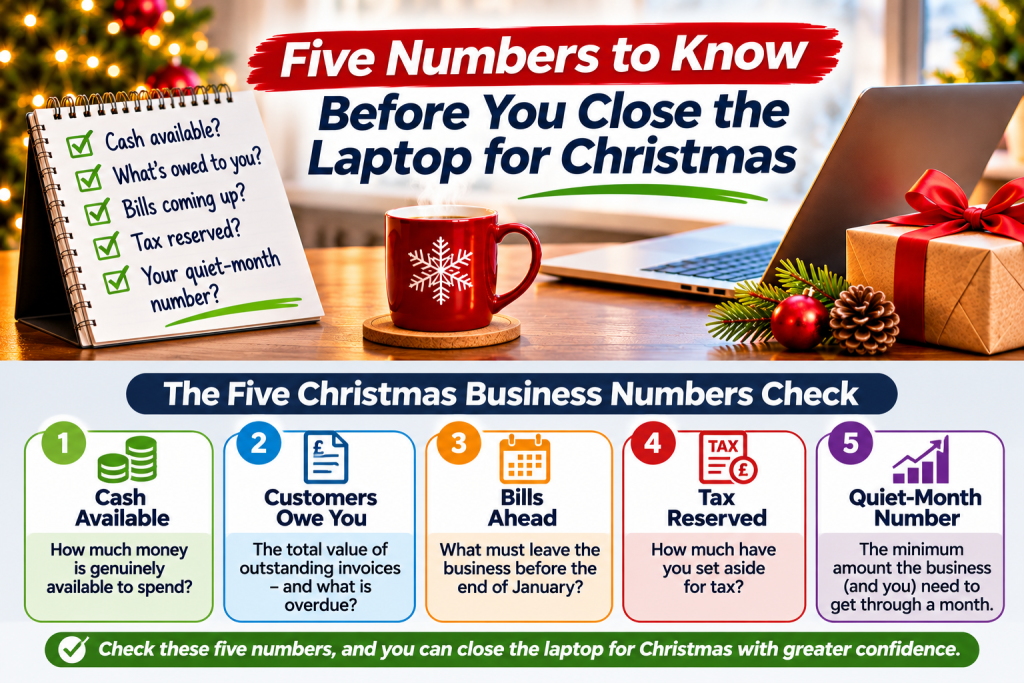
Number 1: How much cash is genuinely available?
Start with the obvious number.
Your bank balance.
Then immediately ask another question:
How much of that money is actually available to spend?
Those are not necessarily the same thing.
Imagine your business account contains £8,000.
That might feel reassuring.
But perhaps:
- £2,000 is reserved for tax.
- £1,000 is VAT that may need to be paid.
- £1,500 is needed for supplier bills.
- £800 is required for January commitments.
Suddenly, the £8,000 bank balance no longer represents £8,000 of free cash.
That distinction matters and, in my experience, is often overlooked.
We explored this earlier in the year in “Your Bank Balance Is Not Your Profit.”
Money sitting in the account may already have a job.
So before Christmas, work out:
Bank balance minus committed money = genuinely available cash.
It does not need to be calculated to the last penny.
You simply need an honest picture.
That is far more useful than repeatedly checking the banking app and hoping the number looks healthy.
Number 2: How much do customers still owe you?
Next, look at money that should be coming into the business.
How much have you invoiced but not yet received?
Perhaps it is:
£500.
£2,000.
£7,000.
Whatever the figure, know it.
Then split it into three groups:
Not yet due
Nothing necessarily needs doing.
Due soon
Keep an eye on it.
Already overdue
Deal with it before Christmas if you can.
This is important because money owed to you is not the same as money available to you.
You may have completed the work.
You may have sent the invoice.
You may even have made a profit on the job.
But until the customer pays, that money cannot pay your bills.
And Christmas can make payment timing even more unpredictable.
Businesses close.
Accounts departments operate reduced hours.
Payment runs move.
Someone who says:
“We’ll get that sorted before Christmas”
may genuinely intend to.
But if they don’t, you may be waiting until January.
So ask:
What is the total value of invoices still outstanding?
Then:
How much of that should already have been paid?
That second number deserves your attention.
Number 3: What must leave the business before the end of January?
Christmas can make January feel further away than it really is.
It is not. While you are eating leftover turkey and deciding whether you ever want to see another mince pie, the business calendar keeps moving.
So before you stop, look ahead.
What bills are already known?
Perhaps:
- Rent.
- Vehicle finance.
- Insurance.
- Software subscriptions.
- Supplier payments.
- Loan repayments.
- Professional fees.
- Tax.
- VAT.
- Wages or subcontractor payments.
- Personal drawings.
Add up the significant commitments due between now and the end of January.
This gives you another useful figure:
What does the business already need to fund?
The point is not to make Christmas feel gloomy.
It is the opposite.
If you know what is coming, you can stop thinking about it.
Uncertainty creates worry.
Clarity creates a plan.
Number 4: How much money is reserved for tax?
This is one of the most important figures for a sole trader to know.
How much have you currently set aside for tax?
Perhaps you have a separate account.
Perhaps you use a banking pot.
Perhaps the money is still sitting in the main account, but you track it separately.
Whatever your method, you should be able to say:
“That amount belongs to tax.”
Why does this matter at Christmas?
Because December can make money look unusually available.
Customer payments arrive.
Spending increases personally.
January may appear quieter.
And tax money can suddenly look like a convenient temporary solution.
But as we have said throughout this series:
Using the tax pot does not remove the problem. It moves it.
So identify the figure.
Protect it.
If your business bank balance is £10,000 but £4,000 is reserved for tax, mentally treat the usable balance as £6,000.
The tax money already has a destination.
Number 5: What is your quiet-month number?
This one brings together several themes we have explored throughout the year.
Ask:
What is the minimum amount the business needs to get through a normal month?
Not your dream month.
Not your best month.
Your minimum.
Include essential business costs such as:
- Insurance.
- Finance.
- Software.
- Rent.
- Vehicle commitments.
- Essential suppliers.
- Professional costs.
Then add the minimum amount you need personally.
Mortgage or rent.
Food.
Utilities.
Essential household spending.
Suppose the business needs £1,800 each month and you personally need £2,200.
Your quiet-month number is around:
£4,000.
That number tells you something useful.
If you genuinely have £8,000 available after tax and other commitments, you have around two months of breathing room.
If you have £1,000, the position is different.
Neither answer needs to create panic.
The purpose is awareness.
Put the five numbers together
Now you have a simple snapshot.
Imagine yours looks like this:
Genuinely available cash: £5,500
Customers still owe: £4,200
Bills due before end of January: £3,000
Tax reserved: £2,500
Quiet-month number: £3,500
You can now see the business much more clearly.
Perhaps everything looks comfortable.
Great.
Perhaps the position is tighter than expected.
That is useful too.
You might decide to:
- Chase an overdue invoice.
- Delay a non-essential purchase.
- Reduce drawings temporarily.
- Move more money into the tax pot.
- Protect some cash for January.
- Speak to your bookkeeper.
The important thing is that you are making the decision with information.
There is a sixth number, but it is not financial
How many days are you actually going to take off?
Put a number on that too.
Three?
Five?
Ten?
Whatever works for you and your business.
Then treat those days as deliberately as you would a customer booking.
If you decide the business closes on 23 December and reopens on 4 January, make that the plan.
Tell customers.
Set the autoresponder.
Update voicemail if necessary.
Then honour the decision yourself.
A Christmas break that contains six hours of “just catching up” every day is not really a break.
You don’t need perfect numbers
This is important.
Some people avoid looking at their finances because they believe every figure must be exact before it is useful.
It does not.
Suppose your quiet-month number is somewhere between £3,500 and £3,800.
That is still useful.
Knowing that customers owe roughly £6,000 is better than thinking:
“There are quite a few invoices outstanding.”
Knowing £4,500 is reserved for tax is better than:
“There should be enough in there somewhere.”
You are not preparing audited accounts.
You are creating clarity.
Watch the January tax deadline
For many people completing Self Assessment, 31 January is a significant date.
That makes the festive period particularly important financially.
Christmas spending, a quieter trading period and a tax payment can arrive very close together.
If that applies to you, do not let the deadline become a January surprise.
Know what has been submitted.
Know what is expected.
And know what money has been reserved.
If you are unsure, this is exactly the time to speak to your accountant, tax adviser or bookkeeper rather than waiting until the final week.
What if the five numbers do not look good?
Then you have learned something valuable.
Perhaps customers owe more than expected.
Perhaps January commitments are higher than you realised.
Perhaps the tax reserve is smaller than it should be.
Perhaps there is almost no cash buffer.
None of those problems improves by not looking at them.
Knowing now gives you options.
You may still have several working weeks available to:
- Invoice.
- Chase payment.
- Reduce spending.
- Adjust drawings.
- Speak to suppliers.
- Seek appropriate professional advice.
Knowledge does not create the problem.
It creates the opportunity to deal with it.
This is what good bookkeeping should give you
Bookkeeping is sometimes treated as a record of things that have already happened.
Receipts entered.
Transactions reconciled.
Invoices recorded.
That is part of it.
But good, regular bookkeeping should also help you answer very practical questions:
What is available?
What am I owed?
What do I owe?
What needs reserving?
Can the business cope with a quieter period?
That is when bookkeeping becomes genuinely useful.
Not simply keeping records because you are required to.
Using information to run the business with greater confidence.
Your 10-minute Christmas numbers check
Before you close the laptop, write these five headings on a piece of paper:
1. Genuinely available cash: £_____
2. Customers owe me: £_____
3. Bills due before end of January: £_____
4. Tax reserved: £_____
5. My quiet-month number: £_____
Then look at the whole picture.
Does it feel comfortable?
Is there something you need to deal with?
Is one number unclear?
That ten-minute exercise could save you hours of worry over Christmas.
Then close the laptop
Once you have checked the numbers, dealt with anything urgent and told customers when you are reopening, give yourself permission to stop.
The business does not need you thinking about it every minute of every day.
You have done the work.
You have checked the position.
You have made the plan.
Christmas can now be Christmas.
Next in the series: The Quiet Week. Seven Questions to Ask About Your Business Before 2027 Begins
Between Christmas and New Year, life often slows down.
It can be one of the few times in the year when a sole trader has enough mental space to think beyond the next customer or the next job.
In our next article, we will use that quieter period to ask seven simple questions about what you want your business to give you in 2027.
Not just how much turnover you want.
But what kind of customers you want.
How you want to spend your time.
What you want to earn.
And what you want the business to feel like this time next year.
Not sure what your five numbers are?
If you are a sole trader or small-business owner in Norfolk and those five numbers are harder to find than they should be, give Zenith Bookkeeping a call.
Good bookkeeping should help you understand your business without having to dig through piles of paperwork or guess what your bank balance really means.
Zenith Bookkeeping can help you bring your records up to date, understand what customers owe, see what is coming up and start 2027 with a clearer financial picture.
Straightforward bookkeeping.
Plain-English support.
And numbers you can actually use.
Call Zenith Bookkeeping today and get a clearer picture before you close the laptop for Christmas.
This article provides general information and should not be treated as individual accounting, tax or financial advice. Your circumstances may differ, so obtain appropriately qualified advice where necessary.