How sole traders can prepare for a proper festive break without worrying about money
You close the laptop for Christmas, as you should; it’s getting closer to the time when you should turn your focus on family and friends.
Often you do this and then open it again two hours later. Not because a customer has called. Because you remembered an invoice. Oh, then there is that supplier bill you meant to check.
And the customer who promised to pay before Christmas.
And the tax money sitting in the account.
And the thought that January might be quieter than usual.
Before long, you are technically on holiday, but your business is still occupying half your head.
For many sole traders and self-employed people, Christmas is not quite the same as taking annual leave from a job.
When an employee takes a week off, their salary usually continues.
When a sole trader stops working, income may slow or stop. That can often make taking a proper break feel uncomfortable, or you constantly feel distracted.
After working hard all year, you should be able to step away for a few days without feeling guilty or worrying constantly about the bank balance. The key to feeling comfortable is all about preparation.
Start by working out what the break will actually cost
Christmas has a habit of making money disappear faster than expected.
But for a sole trader, the cost of the festive period is not just presents, food and personal spending.
The business continues to have commitments while you are not working.
Perhaps you still have:
- Vehicle payments.
- Insurance.
- Software subscriptions.
- Rent or workspace costs.
- Telephone and internet.
- Finance repayments.
- Supplier bills.
- Professional fees.
- Tax or VAT commitments.
- Personal drawings.
None of these automatically disappear because you decide to take ten days off.
So before switching off, ask:
What does the business need to cover while I am away?
Then add:
What do I personally need during the same period?
That gives you a much clearer picture than simply looking at your account balance and hoping it is enough.
Send every invoice you can before you stop
I know this sounds obvious.
But invoicing is one of those jobs that often gets pushed behind the work itself.
You finish a job on Friday.
The invoice can wait until Monday.
Then Monday becomes Wednesday.
Then suddenly it is the last working week before Christmas.
If you have completed the work, send the invoice.
Do not allow December work to become January paperwork unless there is a good reason.
The sooner the invoice goes out, the sooner the payment clock starts.
And if the customer has a Christmas shutdown of their own, sending it late may push payment much further into the new year.
That can and often does create unnecessary pressure in January.
Chase overdue money before everybody disappears
If a customer already owes you money, deal with it before Christmas.
Do not assume:
“They’ll sort it after the break.”
They might.
But “after Christmas” can easily become mid-January.
Then late January.
And meanwhile your own bills still need paying.
Check:
- Which invoices are overdue?
- Which ones are approaching their due date?
- Has the customer been reminded?
- Have they given you a payment date?
- Is there anything preventing payment?
A polite reminder now is much better than spending Christmas wondering whether the money will arrive.
You’re not being difficult, you’re simply making sure the business is being paid for work already completed.
Know what January already needs from you
January can catch people out because attention is focused on Christmas.
The festive period feels like the end of something.
Financially, it is also the beginning of the next month.
Before switching off, look at January.
What is already due?
Perhaps:
- Rent.
- Supplier invoices.
- Insurance.
- Software.
- Vehicle payments.
- Tax.
- VAT.
- Finance.
- Personal household costs.
Then look at what is expected to come in.
Which customer payments are due?
Which are reliable?
Which are already late?
And how much new work is booked?
You don’t need to predict January perfectly. You just need enough visibility to avoid having to reopen the laptop on Boxing Day because you suddenly remembered a major payment.
Protect the tax pot
Christmas can be expensive.
Add this to a quiet January, and that can also create pressure.
That makes money sitting in a tax account very tempting.
You may tell yourself:
“I’ll just borrow a little and put it back when the next customer pays.”
Okay, sometimes that works.
But sometimes it becomes the start of a problem that follows you into the new year.
Tax money already has a job.
Using it to fund Christmas or normal business costs does not remove the future liability.
It only moves the pressure.
If you find yourself repeatedly relying on the tax pot to keep things moving, that is useful information.
It may suggest that your business needs:
- Better cash flow.
- Faster customer payments.
- Stronger pricing.
- Lower costs.
- More controlled drawings.
- A separate business reserve.
Try to leave the tax money alone.
Future you will be grateful.
Create a Christmas buffer
A business reserve does not need to begin with thousands of pounds.
Even a modest festive buffer can make a difference.
Perhaps you decide you want £500 or £1,000 genuinely available to carry the business through the quieter period.
That money is separate from:
- Tax.
- VAT.
- Supplier payments.
- Other committed spending.
It is simply there to give you breathing room.
If you have not built one yet, don’t worry about what you “should” have done earlier.
Start with what you can do right now.
Perhaps part of the next customer payment can be moved across.
Perhaps one planned purchase can wait until January.
Perhaps a strong December job allows you to set something aside.
The point is not perfection.
It is reducing the pressure.
Decide what you need personally
This is another area where Christmas can blur the line between business and personal money.
There are extra expenses.
Family commitments.
Travel.
Food.
Gifts.
Social events.
If you normally take money from the business as and when you need it, the festive period can turn into several unplanned withdrawals.
Instead, decide in advance:
What do I realistically need to take from the business over Christmas?
Then check whether the business can comfortably provide it.
That is much clearer than repeatedly dipping into the account and hoping the balance remains healthy.
Tell customers when you’re closed
One reason sole traders struggle to switch off is uncertainty.
What if somebody needs something?
What if a customer emails?
What if there is an urgent job?
The simplest answer is often communication.
Tell customers:
- When you close.
- When you reopen.
- Whether you will monitor messages.
- What counts as genuinely urgent.
- When they can expect a response.
Put the information on:
- Email autoresponders.
- Social media.
- Your website.
- Voicemail if appropriate.
Customers are usually more understanding when expectations are clear. And you’re less likely to spend every day checking your phone “just in case”.
Being available all the time is not the same as providing good service
This is worth remembering. Sole traders often feel that their personal availability is part of the service.
To be fair, sometimes it is. But if customers have been looked after properly all year, taking a few days away does not suddenly make you unreliable.
Good service is:
- Doing what you said you would do.
- Communicating clearly.
- Meeting agreed deadlines.
- Handling problems professionally.
- Being dependable.
It does not necessarily mean replying to an email on Christmas Day.
A business that only works because the owner is permanently available may be giving you something important to think about for 2027.
Don’t turn the break into an admin week
Another trap is replacing paid work with unpaid work.
You tell yourself:
“I’ll use Christmas to catch up.”
You will sort receipts.
Update the books.
Rewrite the website.
Review prices.
Plan marketing.
Clean up files.
Prepare social media.
Suddenly the Christmas break has become another working week.
There may be one or two things you genuinely want to do.
That’s fine.
But choose them deliberately.
Do not create an enormous list of business jobs simply because customer work has slowed down. I want you to remember that rest has value too.
A proper break can make you better at running the business
It is easy to think of time off as unproductive. But being permanently tired does not create better decisions.
Rest can give you:
- Perspective.
- Energy.
- Patience.
- Creativity.
- Motivation.
- Better judgement.
You may return to the business in January seeing something more clearly than you did in December.
A customer issue.
A pricing problem.
An opportunity.
A process that needs changing.
Sometimes stepping away is what allows you to see the business properly.
What if you genuinely cannot afford to stop?
Then that deserves attention.
Not criticism.
Information.
If missing one week of work immediately creates financial difficulty, ask why.
Perhaps:
- Margins are too tight.
- There is no reserve.
- Customers pay too slowly.
- Drawings are too high.
- The business relies completely on constant personal output.
- Prices do not allow for holidays.
- Too much money is tied up elsewhere.
The solution may not be immediate. But the issue is worth understanding.
A sustainable business should eventually allow its owner some breathing room. That may become one of your most useful goals for 2027.
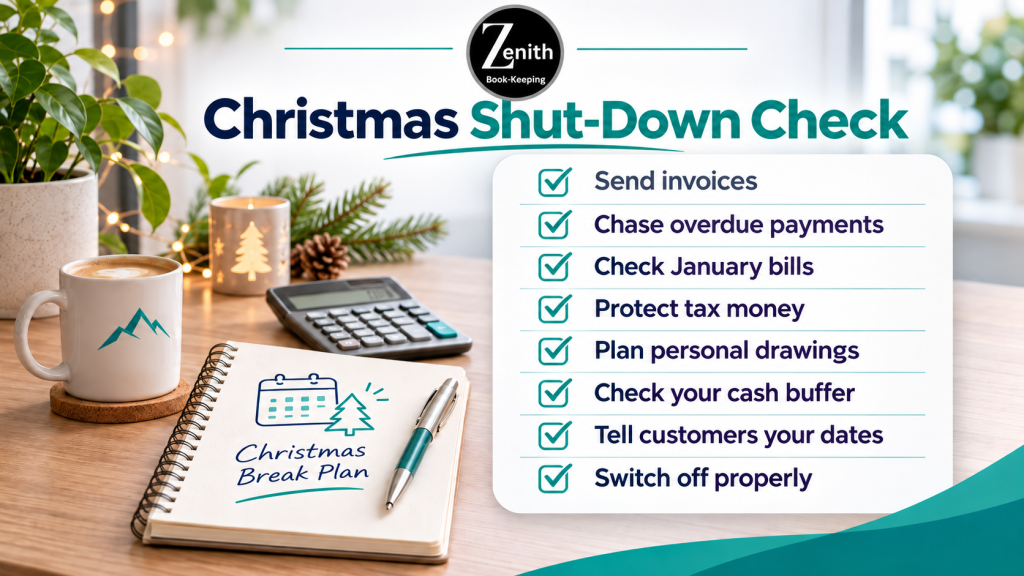
Your Christmas Shut-Down Check
Before finishing for the year, run through this simple checklist.
1. Send every invoice you can
Do not leave completed work waiting unnecessarily.
2. Chase overdue payments
Deal with them before customer offices begin closing.
3. Check January commitments
Know what must be paid before normal trading resumes.
4. Protect tax and VAT money
Do not treat reserved funds as Christmas spending money.
5. Decide your personal drawings
Know what you need rather than dipping into the business repeatedly.
6. Check your cash buffer
Understand what is genuinely available.
7. Tell customers your closing and reopening dates
Set expectations clearly.
8. Decide what you are not going to do
Perhaps this Christmas you are not going to spend Sunday catching up with bookkeeping.
Then switch off.
Properly.
Good bookkeeping makes switching off easier
This is where regular bookkeeping quietly earns its value.
If your records are current, you can answer questions before the break:
- What customers owe you?
- What bills are outstanding?
- How much is reserved for tax?
- What does January look like?
- What money is genuinely available?
- Can you comfortably take your planned drawings?
Without those answers, uncertainty follows you into the holiday.
With them, you can make a plan and leave the business alone for a few days.
That is not just tidy bookkeeping.
It is peace of mind.
A final thought: you have earned a break
Running your own business requires a lot from you.
You’re the person doing the work.
Winning the customers.
Solving the problems.
Making the decisions.
Handling the admin.
Watching the money.
And carrying much of the responsibility when something goes wrong.
So if you can take a few days away over Christmas, take them.
Enjoy them.
The business will still be there when you return.
A little preparation now can help ensure you don’t spend the whole festive break feeling worried or distracted by your business.
Next in the series: Five Numbers to Know Before You Close the Laptop for Christmas
In our next article, we will keep things very practical.
Before you finish for the festive break, there are five numbers every sole trader should ideally know:
- How much cash is genuinely available.
- How much customers owe you.
- What bills are coming.
- What is reserved for tax.
- What the business needs to survive a quiet month.
You do not need a finance degree.
You just need clarity.
Want to switch off for Christmas with fewer financial worries?
If you are a sole trader or small-business owner in Norfolk and are not entirely sure what your business finances look like heading into Christmas and January, give Zenith Bookkeeping a call.
Zenith can help you bring your records up to date, understand what is coming in and going out, and give you a clearer picture before the festive break begins.
Straightforward bookkeeping.
Plain-English support.
And fewer financial surprises when you return in January.
Call Zenith Bookkeeping today and give yourself the chance to enjoy a proper Christmas break with greater financial clarity and peace of mind.
This article provides general information and should not be treated as individual accounting, tax or financial advice. Your circumstances may differ, so obtain appropriately qualified advice where necessary.