A simple review for sole traders who want to start 2027 with greater clarity
The final few weeks of the year have a different feel to them.
For many sole traders and self-employed people, there is still plenty to do. Jobs need finishing. Customers need looking after. Invoices need sending. Loose ends need tying up.
But somewhere in the background, Christmas is getting closer.
And with it comes something many small-business owners do not get very often:
A natural pause.
Perhaps you take a few days off.
Perhaps customers become quieter.
Perhaps the phone rings less.
Whatever form it takes, the end of the year offers a useful opportunity to stop focusing only on what needs to be done next and spend a little time looking at the business itself.
Not with a complicated strategy document.
Not with a spreadsheet containing 47 targets.
Just a straightforward end-of-year MOT.
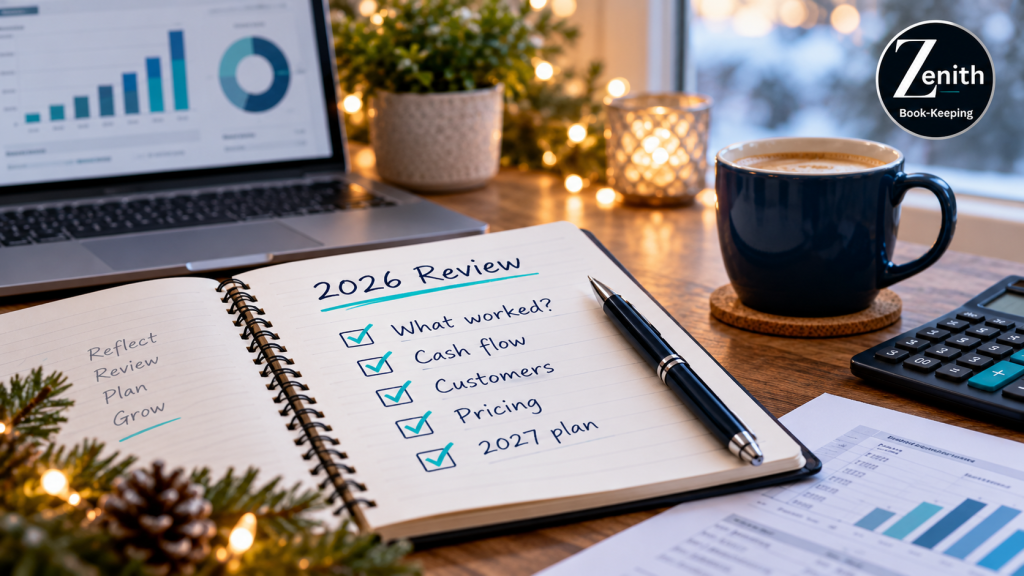
Because before deciding what you want from 2027, it helps to understand what actually happened in 2026.
Start with what went well
Small-business owners can be remarkably good at moving straight from one problem to the next.
A job goes well.
A customer recommends you.
You have a strong month.
You solve a difficult problem.
And almost immediately your attention moves to the next thing that needs dealing with.
The end of the year is a good time to notice what worked.
Ask yourself:
- Which customers were particularly good to work with?
- Which jobs produced the best return?
- Which services were easiest to deliver?
- Where did referrals come from?
- Which marketing activity actually generated business?
- What are you proud of achieving this year?
Do not skip this part.
Understanding what worked gives you clues about what you should do more of next year.
Growth does not always come from inventing something new.
Sometimes it comes from recognising what is already working and doing it more deliberately.
Now look at what caused unnecessary stress
This may be even more useful.
Think back across the year.
What repeatedly made running the business harder than it needed to be?
Perhaps it was:
- Customers paying late.
- Quotes taking too long to prepare.
- Pricing that no longer felt worthwhile.
- Too much work landing at once.
- Not enough work in quieter periods.
- Receipts and paperwork piling up.
- Doing admin in the evening.
- One customer taking far more time than expected.
- Never being completely sure what money was actually available.
Most businesses have one or two recurring irritations that quietly consume time and energy.
The danger is becoming so used to them that they begin to feel normal.
They may be normal.
That does not mean they should stay that way.
Which customers would you happily clone?
This is a useful question because it forces you to look beyond turnover.
Think about your customers this year.
Which ones would you happily have ten more of?
They may not necessarily be the customers who spent the most.
Your best customers might be the ones who:
- Pay promptly.
- Give clear instructions.
- Respect your time.
- Buy regularly.
- Accept fair pricing.
- Recommend you to others.
- Are simply straightforward to work with.
Now consider the opposite.
Which customer relationship repeatedly created problems?
Perhaps the work was profitable enough to justify it.
But perhaps it was not.
This is the point of the exercise.
Do not automatically assume that the biggest invoice represents the best business.
Look at the whole relationship.
What should you stop doing in 2027?
New Year planning usually focuses on adding things.
New goals.
New marketing.
New services.
New customers.
But one of the most useful questions may be:
What should I stop doing?
Perhaps there is a service you no longer enjoy providing.
Perhaps one type of work takes too long for the price.
Maybe you are paying for software you barely use.
Perhaps you still handle something manually that could be simplified.
Maybe you are allowing too much additional work to creep into jobs without charging for it.
Or perhaps you have developed the habit of doing bookkeeping on Sunday afternoon because you never set aside time for it during the week.
Improvement does not always mean doing more.
Sometimes it means removing something that no longer earns its place.
Look at where the money went
This has been a recurring theme throughout our recent articles.
A busy business can still feel strangely short of cash.
So before finishing the year, ask:
Where did the money actually go?
Look beyond the bank balance.
Consider:
- Business costs.
- Personal drawings.
- Tax.
- VAT where applicable.
- Equipment.
- Loan repayments.
- Stock and materials.
- Money still owed by customers.
- Subscriptions and regular expenses.
The purpose is not to account for every penny yourself.
That is what your bookkeeping records help you do.
The purpose is to understand the story.
You may discover the business performed better than it felt.
Or you may discover that costs have crept upwards without you really noticing.
Either way, clarity is useful.
Check what customers still owe you
Before everybody disappears into Christmas mode, review outstanding invoices.
Who still owes you money?
When was it due?
Has the customer been reminded?
Are there invoices that should already have been sent but are still sitting on your to-do list?
This is particularly important at the end of the year.
A customer who says, “We’ll sort that after Christmas,” may effectively delay payment by several weeks.
If money is due, deal with it before the festive slowdown begins.
You are not being difficult.
You are simply keeping the business organised.
Could you cope with a quieter January?
January does not look the same for every business.
For some it is busy.
For others, customers take time to get moving again.
Ask yourself:
If January were quieter than expected, would the business be comfortable?
Look at:
- Cash currently available.
- Tax money already reserved.
- Bills due in January.
- Expected customer payments.
- Personal drawings.
- Any large annual costs approaching.
You do not need to predict the future perfectly.
You simply need to know whether a quieter month would be inconvenient or genuinely difficult.
If the answer makes you uncomfortable, that is useful information to take into 2027.
Check whether your prices still make sense
Prices have a habit of staying the same while everything around them changes.
Fuel costs rise.
Software increases.
Insurance renews.
Suppliers put prices up.
The work takes longer than it used to.
But the customer still pays the same amount you quoted two years ago.
The end of the year is a good time to ask:
- Are my prices still covering the true cost of delivering the work?
- Which services produce the strongest return?
- Where am I giving away time without realising it?
- Am I discounting too easily?
You do not necessarily need to increase every price in January.
But you should understand whether your current pricing still works.
Think about your time as well as your money
A business can make more money and still become worse to run.
That matters.
How did 2026 feel?
Did the business regularly spill into evenings?
Did you take enough time away?
Were you constantly rushing?
Did you spend too much time doing jobs somebody else could eventually handle?
Did you spend enough time winning future work, or were you permanently trapped delivering the work already booked?
Financial success matters.
But so does building a business that you can continue running without exhausting yourself.
A useful goal for 2027 might not be:
“Increase turnover by 20%.”
It could be:
“Make the same money in fewer hours.”
Or:
“Work with fewer, better customers.”
Or:
“Stop doing bookkeeping on Sunday evenings.”
Those are legitimate business goals too.
Choose three improvements, not thirty
Once you have reviewed the year, resist the temptation to create an enormous New Year list.
Choose three meaningful improvements.
For example:
1. Invoice every Friday.
2. Build one month of business reserve.
3. Review prices on our least profitable work.
Simple.
Specific.
Useful.
The point is not to redesign the whole business before January.
It is to start the next year with a clearer sense of what deserves attention.
Good bookkeeping gives you evidence, not guesswork
This is where regular bookkeeping earns its place.
Your records should help you answer questions such as:
- What did we actually earn?
- What did we spend?
- Which months were strongest?
- Who still owes us money?
- Are costs increasing?
- How much have I taken personally?
- What tax needs reserving?
- What does the business genuinely have available?
Without good records, an end-of-year review becomes:
“I think we did alright.”
With good records, you can make decisions based on what actually happened.
That is a much stronger starting point for 2027.
Before you switch off
You deserve to switch off.
Really switch off.
Not sit on the sofa on Boxing Day wondering whether an invoice was paid.
Not spend Sunday afternoon sorting receipts.
Not start January with a vague feeling that you ought to get the business under control.
Take a little time before the festive break to look at the year you have just had.
Celebrate what worked.
Notice what did not.
Decide what needs changing.
Then step away knowing you have given yourself a clearer starting point for 2027.
Next in the series: Was 2026 Actually a Good Year?
In our next article, we will look at one deceptively simple question:
How do you decide whether your business actually had a good year?
Turnover is part of the answer.
But so are profit, cash, customers, time, stress and what the business gave you personally.
We will look beyond the headline numbers and help you assess 2026 from a broader perspective.
Want to start 2027 with a clearer picture of your business?
If you are a sole trader or small-business owner in Norfolk and you would like to understand your numbers more clearly before the year ends, give Zenith Bookkeeping a call.
Whether your records need to be brought up to date, you want a clearer picture of what is coming in and going out, or you simply want to start 2027 feeling more organised, Zenith can help.
Straightforward bookkeeping.
Plain-English support.
And a clearer financial picture of the business you are working so hard to build.
Call Zenith Bookkeeping today and give your business its end-of-year MOT before you switch off for Christmas.
This article provides general information and should not be treated as individual accounting, tax or financial advice. Your circumstances may differ, so obtain appropriately qualified advice where necessary.