
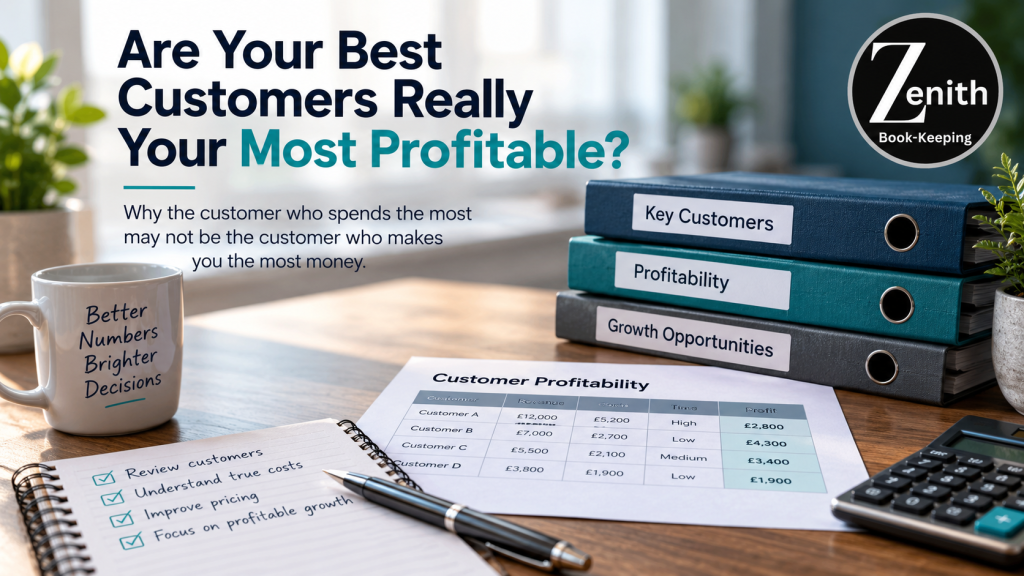
Why the customer who spends the most may not be the customer who makes you the most money
Most businesses know who their biggest customers are. They are usually the names that appear most often on invoices. The customers who spend the most. The ones who seem to account for a significant part of turnover. And because of that, they are often described as the business’s “best customers”.
But are they?
In our recent articles, we have looked at break-even, cash flow and the importance of building enough financial resilience to cope when business becomes quieter.
This article takes the next step.
Because once you understand what the business needs to earn, another question becomes increasingly important:
Which customers are actually helping you earn it?
The customer who spends the most is not necessarily the customer who contributes the most profit. And sometimes, the customer you believe is your most valuable may be consuming considerably more time, attention and money than you realise.
Turnover tells you what they buy
Profitability tells you what they are worth
Imagine two customers.
Customer A spends £12,000 with you each year.
Customer B spends £7,000.
At first glance, Customer A is clearly more important.
But now look a little deeper.
Customer A:
- Requires frequent meetings.
- Regularly changes their mind.
- Expects urgent work.
- Negotiates every quotation.
- Requires additional travel.
- Often asks for small extras without expecting to pay.
- Takes 45 to 60 days to settle invoices.
- Needs repeated reminders before paying.
Customer B:
- Gives clear instructions.
- Buys regularly.
- Rarely creates additional administration.
- Accepts agreed prices.
- Pays within seven days.
- Recommends other customers.
Which one is actually better for the business?
The £12,000 customer may still generate more total profit.
But the answer is no longer obvious.
That is the important point.
Revenue is only the beginning of the calculation.
Some customers cost more to serve than others
Every customer creates costs.
Some are obvious.
For example:
- Materials.
- Stock.
- Delivery.
- Subcontractors.
- Travel.
- Merchant fees.
- Specialist equipment.
But others are much easier to overlook.
Consider the time spent:
- Preparing quotations.
- Attending meetings.
- Answering emails.
- Making changes.
- Correcting misunderstandings.
- Chasing information.
- Rearranging schedules.
- Chasing payment.
- Handling complaints.
- Producing additional paperwork.
That time has value.
Even if you do not send the customer an invoice for it.
A customer who requires an additional four hours of unpaid administration every month is creating a genuine cost to the business. Over a year, that becomes 48 hours. More than a complete working week. And that time could have been spent serving another customer, selling new work or simply finishing work earlier.
A simple customer profitability calculation
You do not need a complicated spreadsheet to get a useful first impression.
Start with this simple calculation:
Customer revenue
minus direct costs
minus the value of your time
= approximate customer profit
For example, imagine a customer pays you £10,000 over the year.
The direct costs associated with serving them are £3,000.
You also estimate that the relationship consumes around 80 hours of your time across delivery, meetings, administration, emails and payment chasing.
If you value that time internally at £40 an hour:
80 hours × £40 = £3,200
Your rough calculation becomes:
£10,000 revenue
− £3,000 direct costs
− £3,200 time cost
= £3,800 approximate contribution
Now compare that with another customer who spends only £7,000.
Perhaps their direct costs are £1,500, and they take 30 hours of your time:
30 hours × £40 = £1,200
So:
£7,000 revenue
− £1,500 direct costs
− £1,200 time cost
= £4,300 approximate contribution
The smaller customer is generating less turnover but may actually be contributing more value.
This is not intended to replace a full accounting calculation. It is a practical management tool. The aim is simply to stop judging a customer by revenue alone.
You can make the exercise even more useful by calculating a rough profitability percentage:
Approximate customer profit ÷ customer revenue × 100
Using the examples above:
- Customer A: £3,800 ÷ £10,000 = 38%
- Customer B: £4,300 ÷ £7,000 = around 61%
That gives you another way to compare relationships of very different sizes.
The important thing is consistency.
Use the same approach across several customers and look for patterns.
The invisible cost of “just one small thing”
Most sole traders will recognise this sentence:
“While you’re here, could you just…?”
The request sounds small. Five minutes. Perhaps ten. You help because you want to provide good service. Then another small request appears. Then another. Individually, none seems significant enough to invoice. But across a year, these extras can become substantial.
This is sometimes called scope creep. The original agreement gradually expands, but the price does not. That means your profit margin quietly shrinks.
The customer may still appear highly valuable because the invoice total is large. But you are providing more and more work for the same money.
Your time has a cost even if you do not charge by the hour
This matters particularly for service businesses.
Suppose you charge £1,000 for a project.
You expect it to take ten hours.
That looks like £100 per hour before considering other costs.
But the project actually takes:
- Ten hours doing the work.
- Two hours in meetings.
- One hour preparing the proposal.
- Two hours answering follow-up questions.
- One hour making additional changes.
- One hour chasing approval and payment.
The true time commitment is now 17 hours. The effective revenue per hour has fallen considerably. That does not automatically make the project unprofitable. But it changes the economics.
If you never record or account for the additional time, you may continue to believe this type of customer or job is more profitable than it really is.
Late payment has a cost too
We have already looked at late payment in previous articles. But it also belongs in the customer-profitability conversation.
Two customers may each buy £5,000 of work. One pays immediately. The other routinely pays 60 days late. Those customers are not commercially identical.
Late payment may create:
- Additional administration.
- Chasing time.
- Cash-flow pressure.
- Reliance on overdrafts or credit.
- Delayed supplier payments.
- Stress.
- Reduced ability to invest elsewhere.
You have effectively financed the late-paying customer for longer.
Again, that does not necessarily mean they are a bad customer. But it should form part of your understanding of the relationship.
Discounts change more than turnover
Some customers achieve “big customers” status partly because they receive substantial discounts.
Perhaps they negotiated a lower rate because they promised volume.
That can make commercial sense. But check whether the promised volume actually compensates for the lower margin.
Suppose your normal price is £1,000 and the direct cost of delivering the work is £400. Your contribution before overhead is £600.
Now give a 20% discount. The selling price falls to £800. But the £400 delivery cost remains. Your contribution is now £400.
The price fell by 20%.
The contribution fell by a third.
You need significantly more volume to generate the same financial result.
The question should therefore not simply be:
“How much do they spend?”
It should also be:
“How much do we keep after serving them?”
Big customers can change your behaviour
There is another issue that does not appear immediately in the numbers.
Dependency.
Imagine one customer accounts for 40% of your annual income. You know they are important. So perhaps you start behaving differently around them. You hesitate to increase prices. You accept slower payment. You squeeze in urgent work. You agree to things outside the original scope. You worry about saying no. You give them priority over smaller customers.
The relationship gradually shifts.
They may still be a good customer.
But you are no longer making decisions in the same way you would with everyone else.
The thought becomes:
“We cannot afford to lose them.”
That sentence should get your attention.
Because the customer you cannot afford to lose may also represent a significant business risk.
What happens if your largest customer disappears?
Try a simple exercise.
Look at your annual turnover.
Now remove your largest customer.
What happens?
Could the business still:
- Cover its overheads?
- Pay you?
- Meet tax commitments?
- Maintain staff or subcontractors?
- Continue investing in marketing?
- Operate without immediately borrowing money?
If the answer is no, the problem may not be the customer.
The problem may be the level of dependency.
Even an excellent customer can create concentration risk if too much of the business depends on them.
They could disappear for reasons completely outside your control.
Perhaps they:
- Close.
- Sell the business.
- Change management.
- Bring the work in-house.
- Move supplier.
- Lose a major contract.
- Experience financial difficulty.
A strong relationship reduces risk. It does not remove it.
The best customer may be the easiest to underestimate
Now consider the opposite type of customer.
They may not spend huge amounts.
But they:
- Buy consistently.
- Rarely complain.
- Pay promptly.
- Provide clear instructions.
- Respect your time.
- Accept fair pricing.
- Require little chasing.
- Recommend other customers.
- Are pleasant to deal with.
These customers are easy to take for granted.
They create little noise. And because they create little noise, they may receive less attention than the customers who constantly demand it. That is worth thinking about.
Sometimes your most valuable customers are not the ones who consume your attention. They are the ones who make doing business easier.
Referrals have value
Customer profitability should not be reduced to one invoice. A customer may generate other benefits.
For example:
- Referring new customers.
- Providing testimonials.
- Introducing you to valuable contacts.
- Giving useful feedback.
- Buying several different services.
- Staying with you for many years.
Suppose Customer C generates only £3,000 of direct annual sales.
But each year they refer two new customers who become worth another £5,000.
Their true commercial value is larger than the original £3,000 suggests.
That is why profitability analysis should involve judgement as well as arithmetic.
You are trying to understand the whole relationship.
Not all difficult customers are unprofitable
It is important not to make the opposite mistake. A demanding customer can still be extremely profitable. Perhaps they require more attention but are willing to pay appropriately for it. Perhaps their work is technically complex but attracts a strong margin. Perhaps they create prestige or access to an important market.
The purpose of this exercise is not to label customers as good or bad. It is to understand the economics. A difficult customer paying an appropriate price may be perfectly worthwhile.
A very pleasant customer receiving too much uncharged work may be less profitable than expected.
The numbers and the relationship need to be considered together.
Look at profitability by type of work too
Sometimes the issue is not the customer.
It is the service.
You may discover that a particular customer appears unprofitable because they mainly buy one of your lower-margin services.
Another service might:
- Take less time.
- Require fewer materials.
- Be easier to schedule.
- Create fewer follow-up problems.
- Generate recurring income.
- Carry a higher margin.
This information can influence your future marketing.
Instead of simply asking:
“How do we find more customers?”
you can ask:
“How do we find more customers who buy our most commercially attractive work?”
That is a much better question.
Create a simple Customer Profitability Check
You do not need sophisticated accounting software to begin. Start with your five or ten largest customers. For each one, consider the following areas.
Revenue
How much have they actually spent with you over the last 12 months?
Direct cost
What does it cost to provide their work?
Include things such as:
- Materials.
- Subcontractors.
- Delivery.
- Travel.
- Directly associated expenses.
Time
How much time does the relationship consume?
Include more than billable delivery.
Consider:
- Administration.
- Meetings.
- Calls.
- Changes.
- Support.
- Chasing.
Payment behaviour
Do they:
- Pay early?
- Pay on time?
- Need occasional reminders?
- Pay consistently late?
- Break payment promises?
Predictability
Do they provide reliable repeat business?
Or do they create sporadic bursts of urgent work?
Future opportunity
Could the relationship realistically grow?
Do they refer others?
Are there additional services they might buy?
Stress and disruption
This is subjective, but it still matters.
Does working with the customer:
- Constantly interrupt your schedule?
- Create emergencies?
- Cause arguments?
- Affect evenings or weekends?
- Prevent you serving other customers well?
Stress is not an accounting entry.
But excessive disruption creates a real cost.
Give each customer a simple score
You can make this even easier by scoring each customer from 1 to 5.
For example:
| Area | Score |
|---|---|
| Revenue value | /5 |
| Profit margin | /5 |
| Pays promptly | /5 |
| Easy to serve | /5 |
| Repeat business | /5 |
| Referral potential | /5 |
| Future opportunity | /5 |
You could then score stress or disruption separately, where a higher score indicates greater difficulty.
Do not worry about making the system scientifically perfect.
The purpose is to help you view customers from several perspectives rather than automatically ranking them by turnover.
The results may surprise you.
You may discover four types of customers
Once you look more closely, your customers may fall into four broad groups.
High value and easy to serve
These are often your stars.
They generate good revenue and margin, pay reliably and are straightforward to work with.
Protect these relationships.
Ask how you can find more customers like them.
High value but difficult to serve
These customers may still be worthwhile.
But something may need changing.
Perhaps:
- Price.
- Scope.
- Payment terms.
- Communication.
- Delivery method.
- Number of meetings.
- Turnaround expectations.
The goal is to improve the relationship’s economics.
Lower value but easy to serve
Do not dismiss these customers automatically.
They may be reliable, profitable and easy to manage.
They can provide valuable stability.
There may also be an opportunity to increase the value of the relationship.
Low value and difficult to serve
This is the group worth examining most carefully.
If a customer:
- Generates little margin.
- Consumes lots of time.
- Pays late.
- Creates stress.
- Has little growth potential.
Ask why the business is continuing on the same terms.
Improve the relationship before ending it
Discovering that a customer is less profitable than expected does not mean you should immediately stop working with them.
Often the problem can be corrected.
Increase the price
If the work genuinely costs more to deliver than originally expected, the price may need to change.
Tighten the scope
Make it clear what is and is not included.
Additional work should be discussed and priced.
Change payment terms
You might require:
- A deposit.
- Staged payments.
- Shorter payment terms.
- Payment in advance.
Reduce unnecessary administration
Could meetings become shorter?
Could approvals be simplified?
Could the customer use a standard process?
Invoice additional work
Stop allowing significant extras to disappear into “customer service”.
Good service does not mean unlimited free work.
Know when a price increase is actually good news
Small-business owners often fear increasing prices.
They imagine every customer leaving.
But suppose you increase a particular customer’s fee by 15% because the relationship has become expensive to service.
One of two things may happen.
They accept.
The relationship becomes more profitable.
Or they decline and leave.
That may initially feel like a loss.
But if the customer was consuming substantial time for very little return, that capacity can now be used for more profitable work.
Not every piece of lost turnover is lost profit.
That distinction matters.
Be careful with “strategic” customers
Businesses sometimes justify unprofitable work by calling the customer strategic.
There can be legitimate reasons for doing this.
Perhaps the customer:
- Provides an important case study.
- Gives access to a new industry.
- Builds credibility.
- Creates referrals.
- Allows you to develop a new skill.
That is fine.
But make the decision consciously.
Ask:
What is the strategic benefit, and how long are we prepared to subsidise the relationship to obtain it?
Without a clear answer, “strategic customer” can become a convenient label for work that simply does not pay enough.
Profitability is not an excuse for poor service
There is an important balance here.
You should not treat lower-value customers badly just because they generate less revenue.
Every customer deserves the service you agreed to provide.
The purpose of understanding customer profitability is to improve business decisions.
It may influence:
- Pricing.
- Marketing.
- Payment terms.
- Service design.
- Capacity.
- Where you spend additional time.
- Which types of customers you actively pursue.
It should not become an excuse to treat people according to the size of their invoice.
Use the information to improve marketing
This is where the exercise becomes particularly valuable.
Suppose your analysis shows that your most commercially attractive customers share several characteristics.
Perhaps they are:
- A particular type of business.
- A certain size.
- Based locally.
- Buying the same service.
- Using you on a recurring basis.
- Paying by Direct Debit.
- Requiring relatively little support.
That gives you a much clearer marketing target.
Instead of:
“We need more customers.”
you can say:
“We need more customers who look like these.”
That can improve:
- Networking.
- Referrals.
- Advertising.
- Website messaging.
- Partnerships.
- Sales activity.
Bookkeeping information is now informing growth.
That is a much more valuable use of your numbers.
Review customers regularly
Customer profitability changes.
A customer who was very profitable two years ago may become less attractive because:
- Your costs have increased.
- Their demands have grown.
- Their price has remained unchanged.
- They now pay more slowly.
- Your business has changed.
- You have better opportunities elsewhere.
Likewise, a smaller customer may grow into an excellent long-term relationship.
Review your key customers perhaps once or twice a year. Not because you are looking for reasons to get rid of people. Because relationships and costs change. Your commercial arrangements need to change with them.
Where good bookkeeping fits in
You cannot understand customer profitability properly without good information.
Accurate bookkeeping can help you see:
- Customer revenue.
- Payment history.
- Direct costs.
- Overdue invoices.
- Changes in sales.
- Overall profitability.
- Trends over time.
Depending on how your systems are structured, you may also be able to identify profitability by:
- Customer.
- Service.
- Product.
- Project.
At Zenith Bookkeeping, we believe bookkeeping should do more than tell you how much tax may be due.
Good records should help you understand the business itself.
Because once you understand where the money is really being made, you can make better decisions about where to spend your time.
A 30-Minute Customer Reality Check
Set aside half an hour this week.
Choose your five largest customers.
Then work through the following questions.
1. How much do they spend?
Write down the approximate annual revenue from each customer.
2. What direct costs are involved?
Consider materials, subcontractors, travel and other obvious costs.
3. How much unpaid time do they consume?
Think about meetings, administration, chasing and additional support.
4. How do they pay?
Promptly?
On time?
Late?
Only after repeated chasing?
5. How easy are they to serve?
Consider communication, clarity, changes and disruption.
6. What is their future potential?
Repeat business?
Additional services?
Referrals?
Growth?
7. Would you actively choose another customer exactly like them?
This may be the most revealing question of all.
If the answer is:
“Absolutely.”
you may have identified your ideal customer.
If the answer is:
“Only if they paid more.”
you may have identified a pricing issue.
And if the answer is:
“Definitely not.”
it may be time to ask why the current relationship continues unchanged.
A final thought: more turnover is not always the answer
Small businesses are constantly encouraged to grow sales.
More customers.
More turnover.
More work.
But not all growth improves the business.
A customer who generates substantial revenue but consumes even more resources can make the business busier without making it healthier.
The goal is not simply to sell more.
It is to build a business where the work:
- Pays properly.
- Uses your time sensibly.
- Supports your overheads.
- Generates profit.
- Creates manageable cash flow.
- Leaves room for the business to grow.
Your biggest customer may indeed be your best customer.
But do not assume it.
Look at the numbers.
Look at the time.
Look at the payment behaviour.
Look at the opportunity.
And look at how the relationship actually feels to operate.
Because the customer who contributes most to your turnover and the customer who contributes most to your business may be two completely different people.
Do you know which customers are really contributing to your business?
If you are a sole trader or small-business owner in Norfolk and would like a clearer understanding of what is happening behind the headline numbers, Zenith Bookkeeping can help.
Accurate, up-to-date bookkeeping can give you better visibility into customer income, costs, outstanding payments, and business performance.
That means your records can become more than something needed for tax.
They can become information you use to make better commercial decisions.
Zenith Bookkeeping provides straightforward bookkeeping support and practical financial organisation in plain English.
Start a conversation with Zenith Bookkeeping today and gain a clearer view of which parts of your business are really working hardest for you.
This article provides general information and should not be treated as individual accounting, tax or financial advice. Customer profitability will depend on the circumstances of each business and should be assessed using appropriate financial information.