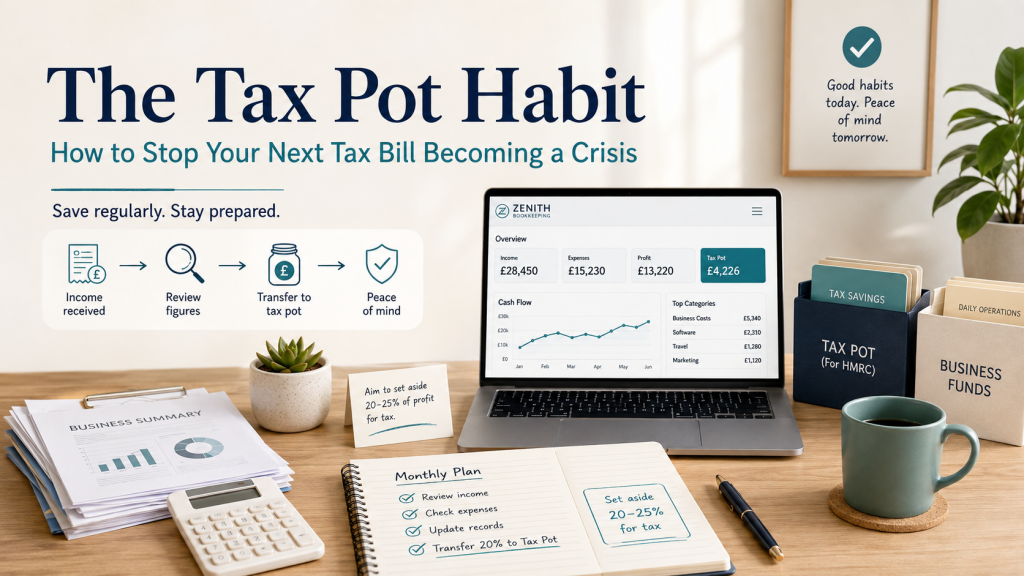
How to Stop Your Next Tax Bill Becoming a Crisis
In our previous article, “Stop Chasing Money in Your Head”, we looked at the stress caused by unpaid invoices and the importance of having a calm, consistent process for collecting the money your business is owed.
But getting paid is only part of the cash-flow picture. Once the money reaches your account, another question appears:
How much of it is genuinely yours to spend?
For many sole traders, the answer is not always clear.
A healthy-looking bank balance can create a sense of reassurance. You pay suppliers, replace equipment, cover household costs and perhaps reward yourself after a busy month.
Then the tax bill arrives.
Suddenly, money that appeared to be available has already been spent, and a predictable business cost has become a financial emergency.
The problem is rarely that the tax bill appeared without warning.
It is that the money needed to pay it was never separated from the rest of the business funds.
A dedicated tax pot can change that.
It does not reduce the amount of tax you owe, but it can reduce the fear, uncertainty and disruption that often surround paying it.
The tax bill that feels like a surprise
Most sole traders know that they will have to pay tax.
The difficulty is that the payment often feels distant while the business is busy earning and spending money.
You receive payments throughout the year, but the tax associated with those earnings may not leave your account until much later.
That delay can create an illusion. The money is visible in the bank, so it feels available. In reality, some of it may already be needed for:
- Income Tax.
- National Insurance.
- Payments on account.
- VAT, where applicable.
- Other business commitments.
When all the money remains together in one account, it becomes difficult to distinguish between:
- Money the business can safely spend.
- Money needed for upcoming bills.
- Money that should be reserved for tax.
- Money required to cover quieter months.
- Money available for you to take personally.
Without that separation, every spending decision involves an element of guesswork.
That is where tax stress begins.
Your bank balance is not your profit
A bank balance tells you how much money is in the account at that moment. It does not tell you how much of that money is genuinely available. Imagine that your business account contains £12,000.
That may appear encouraging, but the balance alone does not show that:
- £2,000 is needed for upcoming supplier bills.
- £1,500 represents VAT collected from customers.
- £3,000 may be needed for Income Tax and National Insurance.
- £1,000 is required for insurance and annual subscriptions.
- Several weeks of household drawings still need to be covered.
The amount that is safely available may be considerably smaller than the headline balance. This is why good financial control is not simply about having money in the bank.
It is about understanding what that money is for.
Turnover is not the same as taxable profit
Another common source of confusion is the difference between turnover, profit and personal income.
Your turnover is broadly the money generated through your business activities before expenses are deducted.
Your taxable business profit is generally calculated after allowable business expenses have been deducted from that income. Sole traders must keep records of their business income and expenses so the relevant figures can be reported through Self Assessment. (GOV.UK)
The amount of tax you eventually owe can also be affected by other factors, including:
- Other sources of income.
- Your Personal Allowance.
- Pension contributions.
- Student loan repayments.
- Tax already deducted elsewhere.
- The tax rates that apply to your total income.
- Payments on account already made.
- Changes in your business profit.
This is why there is no single tax-saving percentage that applies to every sole trader.
You may hear someone say:
“Just put aside 20% of everything you earn.”
That may be a useful starting point for some people, but it is not a reliable calculation for everyone.
For one person, 20% may be more than they need.
For another, it may leave a serious shortfall.
A better approach is to estimate your likely liability using your own figures and review that estimate as the year develops.
What is a tax pot?
A tax pot is simply money set aside from your everyday business funds for taxes.
It might be held in:
- A separate business savings account.
- A designated savings space or pot provided by your bank.
- An HMRC Budget Payment Plan.
- Another clearly separated account that you do not use for ordinary spending.
The essential point is that the money is removed from the balance you treat as available.
Once it enters the tax pot, it has a job.
It is no longer there to cover a new laptop, a quiet sales month or an unexpected household expense.
It is waiting for the tax bill.
That separation creates both practical and psychological clarity.
Instead of looking at one account and wondering how much you can safely use, you can see:
- The money available to operate the business.
- The money already reserved for tax.
Why the tax pot habit reduces stress
Tax stress is often caused by uncertainty rather than the tax itself.
You may find yourself wondering:
- How large will the bill be?
- Have I saved enough?
- Will payments on account apply?
- Can the business afford it?
- Will I have to use a credit card or overdraft?
- What else will need to be postponed?
A tax pot does not answer every question, but it changes the situation from:
“I hope I can find the money.”
to:
“I have been preparing for this throughout the year.”
That is a significant difference.
A planned tax payment may still be substantial, but it is less likely to destabilise the business.
The payments-on-account surprise
Payments on account are one reason a first significant Self Assessment bill can feel much larger than expected.
They are advance payments towards the following year’s tax bill. They normally apply unless your previous Self Assessment tax bill was below £1,000 or more than 80% of the tax was collected outside Self Assessment.
Each payment is normally half of the previous year’s relevant tax liability. The first is due on 31 January and the second on 31 July. Any remaining balance is also generally settled through the following 31 January payment. (GOV.UK)
Consider a simplified example.
Suppose your first Self Assessment liability is £4,000 and the full amount is used to calculate payments on account.
On 31 January, you could be asked to pay:
- The £4,000 tax owed for the completed year.
- A £2,000 first payment on account towards the current year.
The total due on that date would therefore be £6,000.
A further £2,000 payment on account could then be due on 31 July.
This does not mean you have been taxed twice. The payments on account are credited towards the following year’s eventual bill.
However, when nobody has explained the system or the money has not been reserved, the first January payment can feel alarming.
A tax pot should therefore be based not only on the tax relating to the year just completed, but also on any likely payments on account.
Do not assume your payment will be the same every year
Payments on account are based largely on the previous year’s liability, but business income does not always remain consistent.
Your current-year profit may be:
- Higher because the business has grown.
- Lower because sales have slowed.
- Affected by a major purchase or investment.
- Changed by the loss or gain of a large customer.
- Influenced by another source of income.
If your liability is likely to be higher, the existing payments on account may not cover the final bill.
That could leave a balancing payment to make.
If your income or profit has fallen, you may be able to apply to reduce your payments on account. HMRC says a reduction may be possible where business profits or other income have decreased, tax relief has increased, or more tax has been deducted at source. (GOV.UK)
Do not reduce them simply because you would prefer to keep the money in the business.
If they are reduced too far and your eventual bill is higher, interest may be charged on the shortfall.
Use a realistic estimate and obtain professional advice where appropriate.
How much should you put aside?
The safest answer is based on an estimate rather than a guess.
A practical calculation begins with:
- Your expected business income.
- Your likely allowable expenses.
- Your estimated taxable profit.
- Any other taxable income.
- The likely Income Tax and National Insurance due.
- Any payments on account that may be required.
- Tax already paid or deducted.
- The amount already held in your tax pot.
HMRC provides a Self Assessment tax-bill estimator that can give an indication of Income Tax and Class 4 National Insurance based on estimated income. It remains an estimate, so the final position should be checked against your actual records and circumstances. (GOV.UK)
Once you have an estimated annual figure, you can turn it into a regular saving target.
For example, if your estimated total liability is £6,000, you might aim to reserve:
- £500 each month, or
- Approximately £115 each week.
If you already have £2,000 saved and expect the bill in eight months, the remaining £4,000 would require an average of £500 a month.
The purpose of this exercise is not to predict the final bill to the penny.
It is to replace a vague future worry with a visible and manageable plan.
Choose a saving method that suits your income
There are several ways to build a tax pot.
The best method is the one you can follow consistently.
Transfer a percentage whenever a customer pays
Each time money is deposited into the business account, move an agreed-upon percentage into the tax pot.
This can work particularly well for sole traders whose income changes from month to month.
When income is higher, more money is reserved.
When income is lower, the transfer reduces automatically.
The percentage still needs to be based on a sensible estimate. It should not simply be copied from another business owner whose circumstances may be completely different.
Make a weekly transfer
A weekly tax transfer can fit naturally alongside your bookkeeping routine.
You review the income received, check the latest financial position and move the appropriate amount into the tax account.
This keeps tax preparation within business hours and prevents it becoming another task that follows you into the evening.
Make a fixed monthly transfer
A monthly standing order may suit a business with stable, predictable profits.
The benefit is consistency. The transfer happens without requiring a fresh decision each time.
The risk is that a fixed amount may become inaccurate if your profits change substantially.
Review it regularly rather than assuming last year’s figure will remain appropriate.
Use a combination
Some businesses transfer a basic fixed amount each month and then make an additional adjustment after reviewing quarterly figures.
This provides consistency while allowing the tax pot to respond to changes in performance.
Treat the transfer as non-negotiable
The tax pot only works when the money remains there.
A common pattern is:
- Money is transferred into the tax account.
- The business encounters a difficult month.
- The tax money is borrowed temporarily.
- The owner intends to replace it when the next customer pays.
- The next payment is needed for something else.
- The tax pot is never restored.
The problem has not disappeared.
It has only been moved to a later date.
If you repeatedly need to use the tax pot to cover ordinary business costs, that is useful information.
It may indicate:
- Prices are too low.
- Customers are paying too slowly.
- Overheads are too high.
- Personal drawings are unsustainable.
- The business has insufficient reserves.
- Cash-flow timing needs attention.
- Profit is lower than the bank activity suggests.
The answer is not to pretend the tax money is available.
The answer is to investigate why the business cannot operate without using it.
Keep VAT separate too
If you are VAT-registered, the VAT collected from customers is not the same as business income you can freely spend.
It may be reduced by eligible VAT paid on business purchases, but the net amount will normally need to be paid to HMRC through the VAT system.
That money should not be confused with the amount reserved for Income Tax and National Insurance.
You may find it helpful to maintain separate pots for:
- Income Tax and National Insurance.
- VAT.
- General business reserves.
- Planned annual expenses.
The more clearly each pot is defined, the less likely you are to spend money intended for another purpose.
A tax pot is not an emergency fund
It is important to distinguish between money reserved for tax and money held for genuine emergencies.
Your tax pot is for an expected liability.
An emergency fund is for events such as:
- Essential equipment breaking down.
- A sudden loss of income.
- An unexpected repair.
- A period of illness.
- A significant customer defaulting.
- Another unplanned business disruption.
Using the same money for both purposes creates uncertainty.
You may feel secure because there is a balance in the account, but that security disappears when the tax bill is paid.
Where possible, build the two reserves separately.
Accurate bookkeeping makes the estimate stronger
A tax-saving plan is only as reliable as the information behind it.
If your bookkeeping is several months behind, you may not know:
- Your current profit.
- Which expenses have been recorded.
- Whether all income has been included.
- How much customers still owe.
- Whether business and personal transactions have been separated.
- How performance compares with the previous year.
That makes it difficult to judge whether the tax pot is adequate.
Keeping records up to date allows your estimate to be reviewed throughout the year.
It also helps identify changes early.
If profit is rising, you can increase the amount being reserved before a shortfall develops.
If profit is falling, you can review whether the saving target or payments on account should be adjusted.
This is one of the benefits of the move towards more regular digital record-keeping. Making Tax Digital for Income Tax began on 6 April 2026 for sole traders and landlords whose qualifying income exceeded £50,000 in the relevant earlier tax year. The threshold is scheduled to extend to qualifying income over £30,000 from April 2027 and over £20,000 from April 2028. (GOV.UK)
Quarterly reporting does not remove the need to plan for tax payments, but current records can make the likely liability easier to estimate.
Complete your tax return earlier
The Self Assessment filing deadline may be 31 January, but that does not mean you must wait until January to discover what you owe.
Completing the return earlier can provide:
- More time to check the figures.
- Earlier knowledge of the amount due.
- More time to correct a saving shortfall.
- Less pressure during the winter.
- A clearer view of payments on account.
- More opportunity to ask questions.
Submitting early does not normally mean the payment has to be made early.
It means you have replaced uncertainty with information.
Waiting until the final days of January can turn a manageable shortfall into an immediate crisis.
Consider an HMRC Budget Payment Plan
Sole traders who are up to date with their Self Assessment payments may be able to use an HMRC Budget Payment Plan.
This allows weekly or monthly Direct Debit payments to be made towards the next Self Assessment bill. The payments are credited against that future liability, reducing the amount left to pay at the deadline. (GOV.UK)
This can suit someone who prefers the discipline of paying the tax bill directly rather than holding it in a separate savings account.
However, you still need to estimate an appropriate payment amount.
A Budget Payment Plan will not automatically guarantee that the complete bill has been covered.
What if you have not started saving?
The best time to start a tax pot may have been earlier in the year.
The next best time is now.
Do not avoid reviewing the position because you are worried about what you will find.
Begin with four questions:
- What tax period will the next payment cover?
- What is the best current estimate of the amount due?
- How much has already been reserved or paid?
- How much time remains before the deadline?
That will show the likely gap.
You can then:
- Divide the shortfall across the remaining weeks or months.
- Increase the amount transferred from future receipts.
- Reduce unnecessary business spending.
- Review personal drawings.
- Chase outstanding invoices.
- Complete the tax return earlier.
- Speak to your bookkeeper or accountant.
- Contact HMRC promptly if payment difficulties are likely.
Ignoring the issue does not protect you from it.
A realistic plan does.
What if you cannot pay the bill?
If you cannot pay your tax bill in full, deal with the problem as early as possible.
HMRC may allow eligible taxpayers to use a Time to Pay arrangement, under which an overdue tax liability is paid through monthly instalments. The arrangement and eligibility will depend on the circumstances. (GOV.UK)
A Time to Pay arrangement is different from a Budget Payment Plan:
- A Budget Payment Plan helps you make regular payments towards a future bill when your payments are up to date.
- Time to Pay may help you deal with tax that is already due or overdue.
Do not assume an arrangement has been agreed until HMRC confirms it.
Professional advice may also be appropriate, particularly where the amount is substantial or the business is experiencing wider financial difficulty.
Where a good bookkeeper fits in
A bookkeeper does not decide your final tax liability unless they are also appropriately qualified and engaged to provide that advice.
However, good bookkeeping provides much of the information needed to prepare effectively.
A bookkeeper can help you:
- Keep income and expense records current.
- Monitor business profit.
- Separate personal and business transactions.
- Identify money still owed by customers.
- Produce reports for your accountant or tax adviser.
- Maintain clearer records for Making Tax Digital.
- Notice when performance has changed.
- Review whether the amount being reserved still appears realistic.
- Keep tax preparation within a regular business routine.
The greatest benefit is clarity.
Instead of checking your bank account and hoping there’s enough money left, you can make decisions based on current records and a clear plan.
A practical tax-pot routine
A straightforward monthly routine might look like this.
Step one: update the records
Make sure income, expenses and bank transactions are current.
Step two: review profit
Look at what the business has earned after recorded expenses, not simply the total money received.
Step three: update the estimate
Consider whether profit or other circumstances have changed since the previous review.
Step four: check the tax-pot balance
Compare the amount already reserved with the latest estimate.
Step five: make the transfer
Move the agreed amount into the separate account or HMRC plan.
Step six: record the decision
Note how the amount was calculated and when it will next be reviewed.
This routine does not need to take over your week.
It can sit alongside your existing bookkeeping and cash-flow review.
The important thing is that the decision is made consciously, using current information.
Five actions to take this week
Open or designate a separate tax account
Choose somewhere that keeps the money visible but separate from everyday spending.
Estimate the next bill
Use your current records, the HMRC estimator and professional support where appropriate.
Include the possible effect of payments on account.
Choose your transfer method
Decide whether you will transfer:
- A percentage of each receipt.
- A weekly amount.
- A monthly amount.
- A combination reviewed quarterly.
Put the review into your calendar
Do not leave it to memory.
Make the tax-pot review part of the normal working month.
Check whether the current balance is on track
Where there is a shortfall, calculate it now and create a catch-up plan.
A final thought: the tax bill is part of the business
Tax is not an unexpected punishment for having a successful year.
It is one of the financial responsibilities that comes with earning a taxable profit.
The stress often arises because it is treated as a future problem rather than a current business cost.
A tax pot changes that.
Every transfer is a small step towards meeting a known responsibility.
Every review replaces guesswork with information.
Every pound reserved reduces the amount that must be found later.
The goal is not to enjoy paying tax.
It is to reach the deadline without fear, panic or damage to the rest of the business.
When the tax money has already been separated, the bill becomes a payment to make rather than a crisis to survive.
Worried that your next tax bill could catch you out?
If you are a sole trader in Norfolk and would like a clearer understanding of your business records, Zenith Bookkeeping can help.
We provide reliable bookkeeping, practical systems and plain-English support to help you see what the business is earning, what it owes and what may need to be reserved.
With more accurate records and a regular financial routine, you can replace tax uncertainty with greater preparation and peace of mind.
Start a conversation with Zenith Bookkeeping today and begin building a tax habit that supports your business year-round.
This article provides general information and should not be treated as individual tax, accounting or financial advice. Tax liabilities depend on personal circumstances, and rules can change. Check current HMRC guidance and obtain appropriately qualified advice where necessary.